Abhishekam & Vedic Ritual Services · Hyderabad
Dakshinamurthy Abhishekam in Hyderabad
Dakshinamurthy Abhishekam is a traditional Hindu devotional ritual performed in worship of Lord Dakshinamurthy, a revered Guru form of Lord Shiva associated with knowledge, wisdom, learning, and spiritual guidance.
Anugraha Siddhi helps devotees in Hyderabad arrange Dakshinamurthy Abhishekam with experienced Vedic Purohits. The ritual can be planned according to the devotee’s Sankalpam, family tradition, preferred date, and Purohit guidance.
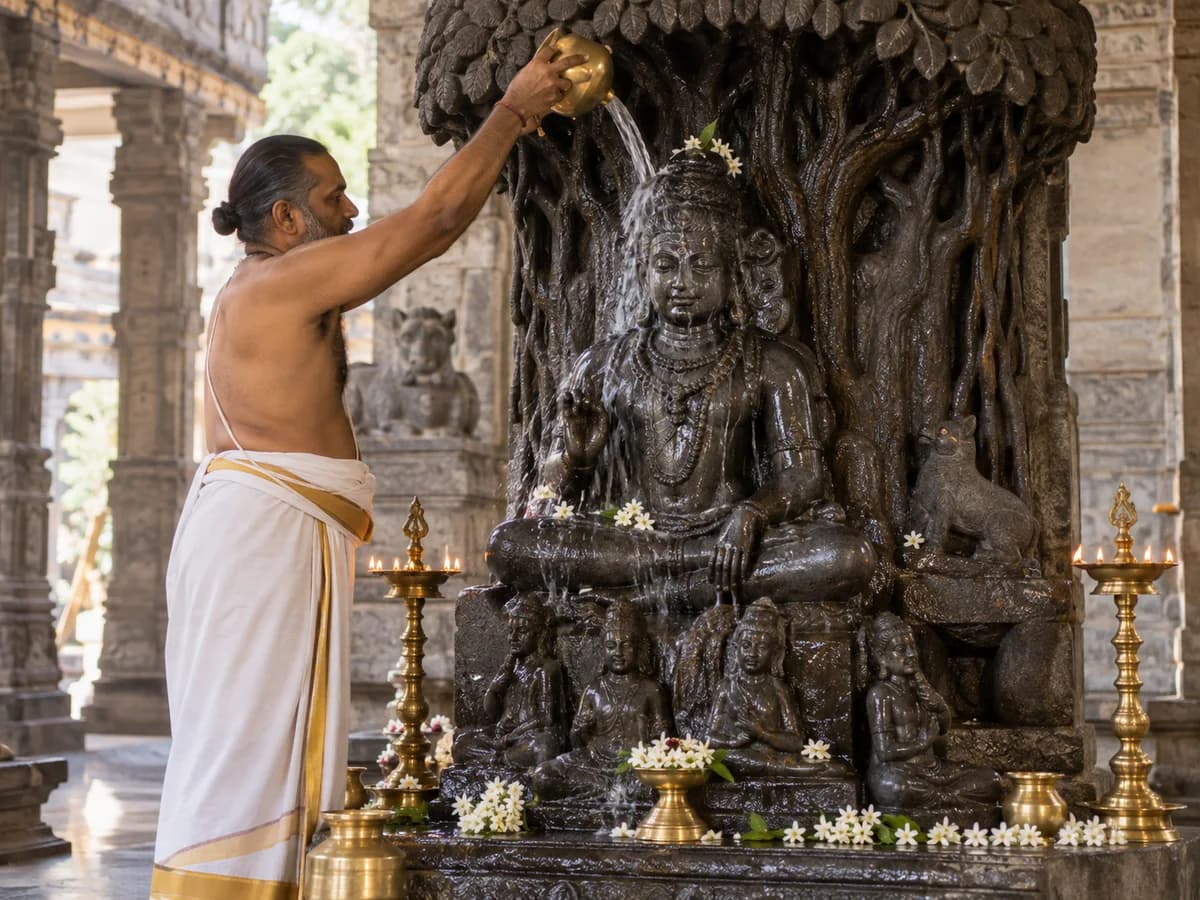
Dakshinamurthy Abhishekam Service in Hyderabad
Anugraha Siddhi helps individuals and families arrange Dakshinamurthy Abhishekam in Hyderabad for devotional worship, special occasions, family observances, and prayers traditionally connected with Guru worship.
The Abhishekam can be discussed according to your preferred date, location, family tradition, and specific devotional requirements.
Before confirming the ritual, the Purohit can guide you regarding the procedure, required Samagri, Sankalpam details, suitable arrangements, and approximate duration.
Depending on the requirement, the ceremony may be arranged at home or another suitable place where the required worship arrangements are possible.
Call or WhatsApp 9032022323 to discuss your requirements.
Book a Purohit
Call / WhatsApp: 9032022323
Quick Overview
| Detail | Information |
|---|---|
| Ritual Name | Dakshinamurthy Abhishekam |
| Deity Worshipped | Lord Dakshinamurthy |
| Associated Deity | Lord Shiva |
| Type | Hindu devotional Abhishekam |
| Commonly Associated Day | Thursday |
| Purpose | Devotional worship, Guru worship, prayer and traditional observance |
| Location | Hyderabad, Telangana |
| Purohit | Experienced Vedic Purohit |
| Languages | Telugu and English |
| Samagri | Can be discussed before booking |
| Booking | Call or WhatsApp |
| Contact | 9032022323 |
What Is Dakshinamurthy Abhishekam?
Dakshinamurthy Abhishekam is a traditional form of worship dedicated to Lord Dakshinamurthy, who is revered as a Guru form of Lord Shiva. During the ritual, the deity is ceremonially bathed with appropriate Abhishekam offerings while prayers, mantras, Archana, and other devotional practices are performed according to the tradition being followed.
Lord Dakshinamurthy is traditionally associated with knowledge, wisdom, learning, spiritual understanding, and the Guru principle.
In traditional iconography, Dakshinamurthy is commonly represented as Lord Shiva in the role of the divine teacher.
The exact Abhishekam procedure is not necessarily identical in every family or temple. Mantras, offerings, sequence, and additional worship may vary depending on sampradaya, regional practice, family custom, and Purohit guidance.
Why Is Dakshinamurthy Abhishekam Performed?
Devotees may perform Dakshinamurthy Abhishekam as an expression of devotion to Lord Shiva in his Dakshinamurthy form.
The ritual may be performed for:
- Regular devotional worship
- Guru worship
- A personal or family Sankalpam
- Prayer related to learning and knowledge
- Spiritual reflection and discipline
- A special family or religious occasion
- Offering gratitude
- Following a family tradition
- Worship connected with education or study
- Observance on a Thursday
- Guru Purnima or another traditionally significant occasion
Some families may particularly consider Dakshinamurthy worship when praying for knowledge, clarity, learning, or spiritual understanding.
These associations belong to Hindu devotional traditions and should not be interpreted as guarantees of academic success, examination results, career advancement, financial improvement, or any other specific outcome.
Importance of Lord Dakshinamurthy Worship
Lord Dakshinamurthy holds an important place in Shaiva traditions as a form of Lord Shiva associated with the role of Guru or teacher.
The worship of Dakshinamurthy is traditionally connected with the pursuit of knowledge, wisdom, understanding, and spiritual learning.
For devotees, Dakshinamurthy Abhishekam provides an opportunity to dedicate time to prayer, Sankalpam, mantra recitation, and devotional worship.
Guru Tattva
Dakshinamurthy represents the principle of Guru in Hindu tradition. Devotees may therefore worship Lord Dakshinamurthy while expressing respect for teachers, spiritual guidance, and the pursuit of knowledge.
Knowledge and Learning
Lord Dakshinamurthy is traditionally associated with knowledge and wisdom. Students and families may therefore include his worship as part of their prayers connected with education and learning.
Shaiva Worship
As a form of Lord Shiva, Dakshinamurthy worship may also form part of the regular devotional practices of families following Shaiva traditions.
Personal Sankalpam
The Abhishekam may also be performed for a personal or family Sankalpam according to the devotee’s faith and tradition.
The spiritual importance of the ceremony should be understood through devotion and traditional worship rather than through promises of specific worldly results.
When Is Dakshinamurthy Abhishekam Performed?
Dakshinamurthy Abhishekam may be performed on a suitable day according to the devotee’s Sankalpam, family tradition, Panchangam, and Purohit guidance.
Thursday
Thursday is commonly associated with Guru worship, and special worship of Lord Dakshinamurthy is observed on Thursdays in several temple traditions.
Because of this association, some devotees prefer to perform Dakshinamurthy Abhishekam on a Thursday.
Guru Purnima
Some devotees may also choose Guru Purnima for worship associated with the Guru principle.
Important Study or Learning Periods
Families may choose to perform the ritual as a devotional observance when a child or family member begins an important period of education or study.
This should be understood as a prayerful religious practice rather than a guarantee of academic performance.
Personal or Family Occasion
The ceremony may also be arranged according to a personal Sankalpam, family tradition, or another religious occasion.
There is no need to assume that the same day is compulsory for every devotee.
For an appropriate date and time, discuss your requirement with the Purohit before confirming the ceremony.
How Is Dakshinamurthy Abhishekam Performed?
The exact Dakshinamurthy Abhishekam Vidhanam may vary according to the Purohit, sampradaya, family tradition, and type of arrangement.
A general ceremony may include the following stages.
1. Preparation of the Pooja Area
The worship area is cleaned and prepared before the ceremony.
The Dakshinamurthy deity or appropriate worship arrangement, lamps, flowers, Abhishekam materials, vessels, Naivedyam, and other required Pooja items are kept ready.
2. Sankalpam
The ceremony may begin with Sankalpam.
The devotee states the intention for performing Dakshinamurthy Abhishekam with guidance from the Purohit.
Depending on the tradition, the Purohit may request details such as the devotee’s name, Gotram, Nakshatram, and family information where applicable.
3. Ganapati and Preliminary Prayers
Traditional worship may begin with prayers to Lord Ganesha and other preliminary rituals.
The exact preliminary sequence depends on the Vidhanam being followed.
4. Dakshinamurthy Invocation and Prayers
The Purohit may recite appropriate prayers and mantras connected with Lord Shiva and Lord Dakshinamurthy.
The mantra sequence can differ according to the tradition and type of ceremony.
5. Abhishekam
The Dakshinamurthy deity is ceremonially bathed with the selected Abhishekam Dravyas.
Depending on the tradition, suitable materials such as clean water, milk, curd, honey, Panchamrutham, sandal-related preparations, or other prescribed offerings may be used.
Not every ceremony requires every Abhishekam material.
The final list should therefore be confirmed with the Purohit.
6. Alankaram and Archana
After the Abhishekam, the deity may be cleaned and appropriately decorated.
Flowers and other permitted offerings may be used.
Archana and appropriate Namavali or prayers may then be performed according to the ritual arrangement.
7. Naivedyam
Suitable Naivedyam may be offered to Lord Dakshinamurthy.
The required Naivedyam can be confirmed while discussing the Samagri list.
8. Mangala Harathi and Conclusion
The worship may conclude with Mangala Harathi and prayers.
Prasadam may then be distributed among participating family members.
The exact sequence can change according to sampradaya and Purohit guidance. Anugraha Siddhi’s current service procedure likewise describes Sankalpam and preliminary Ganapathi Pooja, Abhishekam, Alankaram and Archana, followed by Naivedyam, Aarti and Prasadam.
Dakshinamurthy Abhishekam Benefits
Devotees traditionally associate Dakshinamurthy worship with knowledge, wisdom, learning, Guru Bhakti, and spiritual understanding.
These should be understood as devotional and religious associations rather than guaranteed outcomes.
Devotion to Lord Shiva
The Abhishekam provides an opportunity to worship Lord Shiva in his Dakshinamurthy form through traditional devotional practices.
Guru Worship
Lord Dakshinamurthy represents the Guru principle in Hindu tradition.
Devotees may perform the ritual while expressing gratitude and reverence towards teachers and spiritual guidance.
Prayer Related to Knowledge
Because Dakshinamurthy is traditionally associated with wisdom and knowledge, devotees may include the worship in prayers connected with learning.
Student and Family Worship
Students may participate with their family as part of a devotional practice associated with education and learning.
Focused Spiritual Practice
The ritual provides dedicated time for Sankalpam, mantra recitation, prayer, and spiritual reflection.
Following Family Tradition
Families that traditionally worship Lord Dakshinamurthy may perform Abhishekam as part of their established religious practice.
Expression of Gratitude
Devotees may perform the ritual simply as an offering of gratitude and devotion.
Dakshinamurthy Abhishekam should not be presented as a guarantee of better marks, examination success, improved memory, employment, marriage, financial results, or removal of every personal difficulty.
Dakshinamurthy Abhishekam and Dakshinamurthy Pooja
Dakshinamurthy Abhishekam and Dakshinamurthy Pooja are closely related forms of worship, but the terms should not automatically be treated as identical.
Dakshinamurthy Abhishekam specifically refers to ceremonial bathing of the deity with appropriate offerings as part of worship.
Dakshinamurthy Pooja is a broader term and may include:
- Sankalpam
- Invocation
- Mantra recitation
- Archana
- Flowers
- Naivedyam
- Harathi
- Other traditional worship practices
An Abhishekam may be included within a larger Pooja arrangement.
If you specifically want Dakshinamurthy Abhishekam, mention this while booking so that the required Abhishekam materials and arrangements can be discussed.
Similarly, Dakshinamurthy Homam should not automatically be assumed to be part of Dakshinamurthy Abhishekam. A Homam is a separate fire-based ritual and should be discussed separately if required.
Samagri for Dakshinamurthy Abhishekam
The Samagri required can vary according to the selected ritual procedure and Purohit tradition.
A general reference list may include:
- Clean water
- Milk
- Curd
- Honey
- Panchamrutham ingredients where required
- Sandal paste
- Turmeric where applicable
- Kumkum where applicable
- Vibhuti
- Flowers
- Flower garlands
- Bilva leaves where appropriate
- Fruits
- Coconut
- Betel leaves
- Betel nuts
- Incense
- Camphor
- Cotton wicks
- Oil or ghee for the lamp
- Diya
- Naivedyam items
- Clean cloth
- Pooja vessels
- Other materials recommended by the Purohit
This is only a general reference.
Do not purchase specialised materials solely from a generic online list.
The exact Samagri should be confirmed after the type of Dakshinamurthy Abhishekam, venue, and ritual procedure are finalised.
Samagri may be arranged by Anugraha Siddhi or by the devotee depending on the selected requirement and package.
Confirm who will arrange each item before the day of the ceremony.
Booking Checklist for Dakshinamurthy Abhishekam
Before confirming your booking, it is useful to discuss the following details with Anugraha Siddhi:
| Booking Detail | What to Confirm |
|---|---|
| Preferred Date | Share the date you are considering |
| Preferred Time | Discuss suitable timing with the Purohit |
| Location | Home or other agreed venue |
| Sankalpam | Explain the purpose or devotional requirement |
| Family Details | Provide Gotram or Nakshatram if required |
| Participants | Mention approximately how many people will participate |
| Abhishekam Type | Confirm the required ritual arrangement |
| Samagri | Confirm what Anugraha Siddhi provides and what you should arrange |
| Language | Telugu or English |
| Additional Rituals | Confirm separately rather than assuming they are included |
| Duration | Ask for the expected duration of your selected arrangement |
| Package | Confirm the current inclusions before booking |
Providing these details beforehand helps the Purohit understand the requirement and prepare appropriately.
Call / WhatsApp: 9032022323
Dakshinamurthy Abhishekam Cost in Hyderabad
There is no single price that applies to every Dakshinamurthy Abhishekam.
The cost can vary depending on the selected arrangement and family requirements.
Factors that may affect the cost include:
- Type of Abhishekam
- Duration of the ceremony
- Number of Purohits required
- Samagri requirements
- Whether Samagri is arranged by the devotee or service provider
- Location of the ceremony
- Additional Archana or mantra requirements
- Additional Pooja requested
- Other ritual arrangements
A basic Abhishekam and an extended ceremony with additional rituals may require different arrangements.
For this reason, it is better to discuss the requirement before assuming a fixed package price.
For current Dakshinamurthy Abhishekam package details in Hyderabad:
Call / WhatsApp: 9032022323
Why Choose Anugraha Siddhi for Dakshinamurthy Abhishekam in Hyderabad?
Anugraha Siddhi helps devotees arrange traditional Hindu Pooja and Vedic ritual services in Hyderabad.
5+ Years of Experience
Anugraha Siddhi has more than 5 years of experience in helping families arrange Hindu religious services and Purohit requirements.
Experienced Vedic Purohits
The ceremony can be arranged with an experienced Purohit familiar with traditional ritual practices.
Purohit guidance is available from a Vedic Purohit with 5+ years of experience. Confirm availability and your ritual requirements when booking.
Telugu and English Support
Devotees can discuss their requirements in Telugu or English.
Guidance Before Booking
You can discuss the date, Sankalpam, location, Samagri, ritual requirements, and other arrangements before confirming your booking.
Clear Samagri Planning
The required Pooja materials can be discussed in advance so that the family knows what needs to be kept ready.
Hyderabad Service
Dakshinamurthy Abhishekam arrangements are available for devotees in Hyderabad based on Purohit availability and ritual requirements.
Traditional and Practical Approach
Rather than assuming that every family requires the same ritual format, the exact procedure can be discussed according to family tradition, Sankalpam, and Purohit guidance.
Book a Purohit
Call / WhatsApp: 9032022323
Frequently Asked Questions
1. What is Dakshinamurthy Abhishekam?
Dakshinamurthy Abhishekam is a traditional Hindu devotional ritual in which Lord Dakshinamurthy, a Guru form of Lord Shiva, is worshipped through ceremonial Abhishekam, prayers, mantra recitation, Archana, and other appropriate devotional practices.
2. Who is Lord Dakshinamurthy?
Lord Dakshinamurthy is revered in Hindu tradition as a Guru form of Lord Shiva and is traditionally associated with knowledge, wisdom, learning, and spiritual understanding.
3. Why is Dakshinamurthy Abhishekam performed?
Devotees may perform it for regular worship, Guru devotion, a personal Sankalpam, prayer related to knowledge and learning, gratitude, or as part of a family religious tradition.
4. Which day is good for Dakshinamurthy Abhishekam?
Thursday is traditionally associated with Guru worship and is commonly chosen for Lord Dakshinamurthy worship. However, the suitable day can depend on family tradition, Panchangam, Sankalpam, and Purohit guidance.
5. Can Dakshinamurthy Abhishekam be performed on Thursday?
Yes. Thursday is commonly associated with Guru worship, and Dakshinamurthy worship is traditionally observed on Thursdays.
6. Can students participate in Dakshinamurthy Abhishekam?
Yes. Students and other family members may participate in appropriate parts of the ceremony according to the guidance of the Purohit.
Lord Dakshinamurthy is traditionally associated with knowledge and learning, but the ritual should not be regarded as a guarantee of examination or academic results.
7. Can Dakshinamurthy Abhishekam be performed at home?
It may be arranged at home when the required deity setup, space, materials, and ritual arrangements are suitable.
Discuss the venue with the Purohit beforehand.
8. What items are required for Dakshinamurthy Abhishekam?
Depending on the tradition, the ceremony may require water, milk, curd, honey, Panchamrutham ingredients, sandal paste, Vibhuti, flowers, fruits, Bilva leaves where appropriate, incense, camphor, lamps, Naivedyam, and other Pooja materials.
The final Samagri list should be confirmed with the Purohit.
9. Is Dakshinamurthy Abhishekam the same as Dakshinamurthy Pooja?
Not exactly.
Dakshinamurthy Abhishekam specifically involves ceremonial bathing of the deity.
Dakshinamurthy Pooja is a broader form of worship that may include Sankalpam, prayers, Archana, Naivedyam, Harathi, and other rituals.
An Abhishekam may form part of a larger Pooja.
10. Is Dakshinamurthy Homam included in the Abhishekam?
Not automatically.
Homam is a separate fire ritual. If you require Dakshinamurthy Homam or another additional ritual, confirm it separately while booking.
11. How long does Dakshinamurthy Abhishekam take?
The duration depends on the type of Abhishekam, mantra recitation, Archana, additional Pooja, number of Purohits, and other arrangements.
The approximate duration can be confirmed after discussing your requirement.
12. Do I need to provide Gotram and Nakshatram?
The Purohit may request Gotram, Nakshatram, names, or other family details for Sankalpam depending on the ritual tradition.
Share the details you have when making the booking.
13. Can Anugraha Siddhi arrange the Samagri?
Samagri arrangements depend on the selected service and package.
Anugraha Siddhi may arrange the required materials, or the devotee may arrange them according to the list provided.
Confirm the arrangement before booking.
14. How much does Dakshinamurthy Abhishekam cost in Hyderabad?
The cost depends on the type of Abhishekam, duration, Purohit requirement, Samagri, location, and additional rituals requested.
Contact Anugraha Siddhi for the current package details based on your requirement.
15. How can I book Dakshinamurthy Abhishekam in Hyderabad?
Contact Anugraha Siddhi and share your preferred date, location, Sankalpam, and ritual requirements.
The available Purohit, Samagri arrangements, timing, and package details can then be discussed before confirmation.
Call / WhatsApp: 9032022323
Book Dakshinamurthy Abhishekam in Hyderabad
If you are planning Dakshinamurthy Abhishekam for yourself, your child, or your family, Anugraha Siddhi can help you arrange the ceremony with an experienced Vedic Purohit in Hyderabad.
Share your preferred date, location, Sankalpam, and other requirements so that the appropriate ritual arrangements can be discussed beforehand.
Book a Purohit
Call / WhatsApp: 9032022323
Anugraha Siddhi — Traditional Hindu Pooja & Vedic Ritual Services in Hyderabad
Email: anugrahasiddhi@gmail.com