6 items

Archana & Offerings — Pooja Kumkum, Turmeric, Akshata

Ritual-grade pooja kumkum, turmeric, akshata and sandal paste, the nine grains, and betel leaves with areca nuts supplied fresh — the archana items that every pooja, homam and abhishekam starts and ends with. What each is for, and what to look for when buying, is below.

About these items

Where archana & offerings come into a pooja

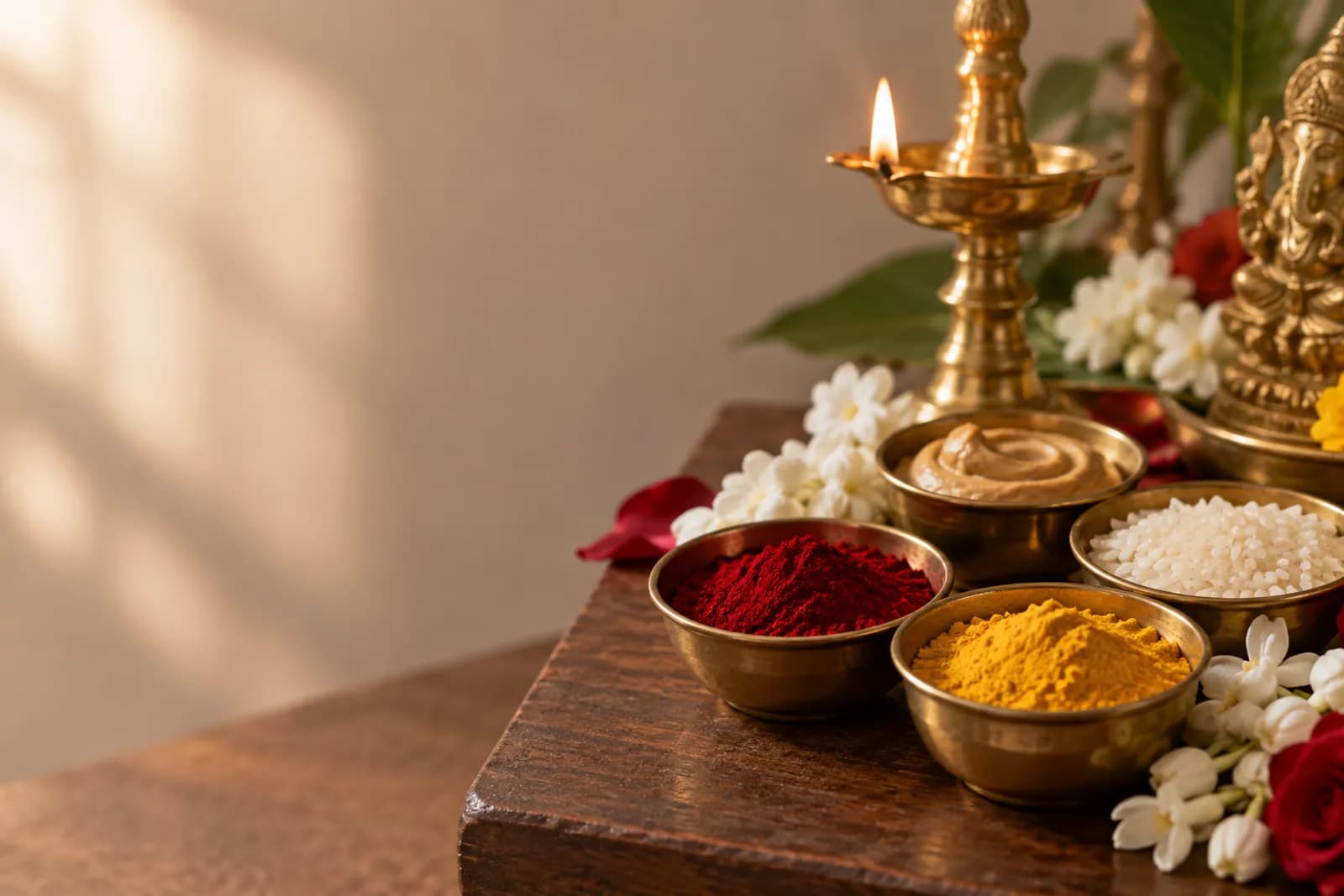
Every archana runs through the same five things: turmeric (pasupu) for the Ganapathi that opens the pooja and for the sacred thread, kumkum (kumkuma) for the deity's mark and for the archana at each name, sandal paste (gandham) for the deity's dressing and the abhishekam, akshata — rice mixed with turmeric — offered with each name and used to bless, and flowers. A household that performs pooja daily uses a little of each; a ceremony uses them in quantity, and a kumkumarchana uses kumkum by the quarter-kilo.

What separates ritual-grade from a bazaar packet is what is in it. Kumkum should be turmeric and lime, not a synthetic red; turmeric should be whole roots ground fresh or a powder that is nothing else; sandal should be sandalwood, not a scented starch. These packs are that, in quantities from a month of daily pooja to a Chandi Homam.

In this category

What we stock in Archana & Offerings

50g, 100g, 250g packs

Kumkum

Ritual-grade kumkum for archana and the kalasam.

Made from turmeric and slaked lime, the traditional way, so it is safe on the skin and on a silver image. Deep red without a synthetic dye. The 50g pack is a month of daily pooja; 250g is a kumkumarchana or a Devi pooja.

100g packs, or whole roots

Turmeric (Pasupu)

Whole roots and powder, for archana and the sacred thread.

Whole roots for the pasupu Ganapathi, the kalasam and the thread, and a plain ground powder with nothing added. Telugu households keep both; a Gruha Pravesham or a wedding uses the roots in quantity.

250g packs

Akshata

Unbroken rice mixed with turmeric, prepared for blessing.

Unbroken raw rice mixed with turmeric and a touch of ghee so it does not scatter — the grain offered with each name of the Ashtottara and thrown in blessing. Prepared fresh for the pack; a 250g pack serves one ceremony.

50g jars

Sandal Paste (Gandham)

Sandalwood paste and powder for abhishekam and archana.

Sandalwood ground to a paste for the deity's dressing and the abhishekam dravya, and the powder for the archana. Sandalwood only, without a starch base; keep the jar closed and it lasts a season.

Nine-bag set

Navadhanyam

The nine grains, bagged separately by graha.

The nine grains in nine bags — wheat, rice, red gram, green gram, chickpea, white beans, sesame, black gram and horse gram — for the navagraha mandala, the Vastu offering, Gruha Pravesham and Bhoomi Pooja. The bags are labelled by graha.

Bundles of 25

Betel Leaves & Areca Nuts

Tamboolam pairs, supplied fresh for the ceremony date.

Tamboolam pairs — two betel leaves and an areca nut per set — supplied fresh against the ceremony date because the leaf does not keep. A household pooja uses one or two sets; a vratam with guests uses one per woman attending.

Sizes and pack quantities vary by supplier and season. Fresh items — flowers, mango leaves, banana stems and tamboolam — are supplied against your ceremony date, so tell us the date when you enquire.

Choosing and using

Before you buy

1

Buy by the ceremony, not by the packet

A daily pooja uses a pinch; a Satyanarayana Pooja uses a 50g pack of each; a kumkumarchana uses 250g of kumkum alone. Tell us the ceremony and the packs are sized to it.

2

Turmeric roots and powder are different items

The root makes the pasupu Ganapathi and is tied into the kalasam thread; the powder is for the archana and the thread's colour. Most ceremonies need both.

3

Fresh items are date-bound

Betel leaves, flowers and mango leaves are supplied on the ceremony date. Give the date when ordering; the dry items can be sent ahead.

4

A kit may already include these

Every complete kit carries the archana set. Order these packs on their own when you are building your own set, or for a ceremony that needs more than a kit's quantity.

Common questions

Before you book

What is pooja kumkum made of?

Traditional kumkum is turmeric powder treated with slaked lime, which turns it red; that is what these packs are. Synthetic reds are sold as kumkum too, and are best avoided on the skin and on silver images.

What is akshata and how is it prepared?

Unbroken raw rice mixed with turmeric — and a little ghee or water so it binds — offered with each name during the archana and thrown over the family in blessing. It is prepared fresh; the packs are mixed for the order.

Which grains are in navadhanyam?

Wheat (Surya), rice (Chandra), red gram (Kuja), green gram (Budha), chickpea (Guru), white beans (Sukra), sesame (Sani), black gram (Rahu) and horse gram (Ketu). The nine-bag set is labelled in that order.

How much kumkum does a kumkumarchana need?

A Lalitha Sahasranama kumkumarchana uses roughly 250g; a Chandi Homam uses more. The 250g pack is sized for one archana.

Are betel leaves sent with the dry items?

No — they are supplied fresh against your ceremony date, as are flowers and mango leaves. Dry items can be sent ahead.

How do I order?

Tell us the ceremony date when you enquire. We confirm availability, the final contents and the price before anything is charged; fresh items are supplied against the date.

Other categories

Also stocked

All items →

Would a complete kit be simpler?

If you are starting from nothing, a ceremony kit gathers all of this in one box with the contents listed.