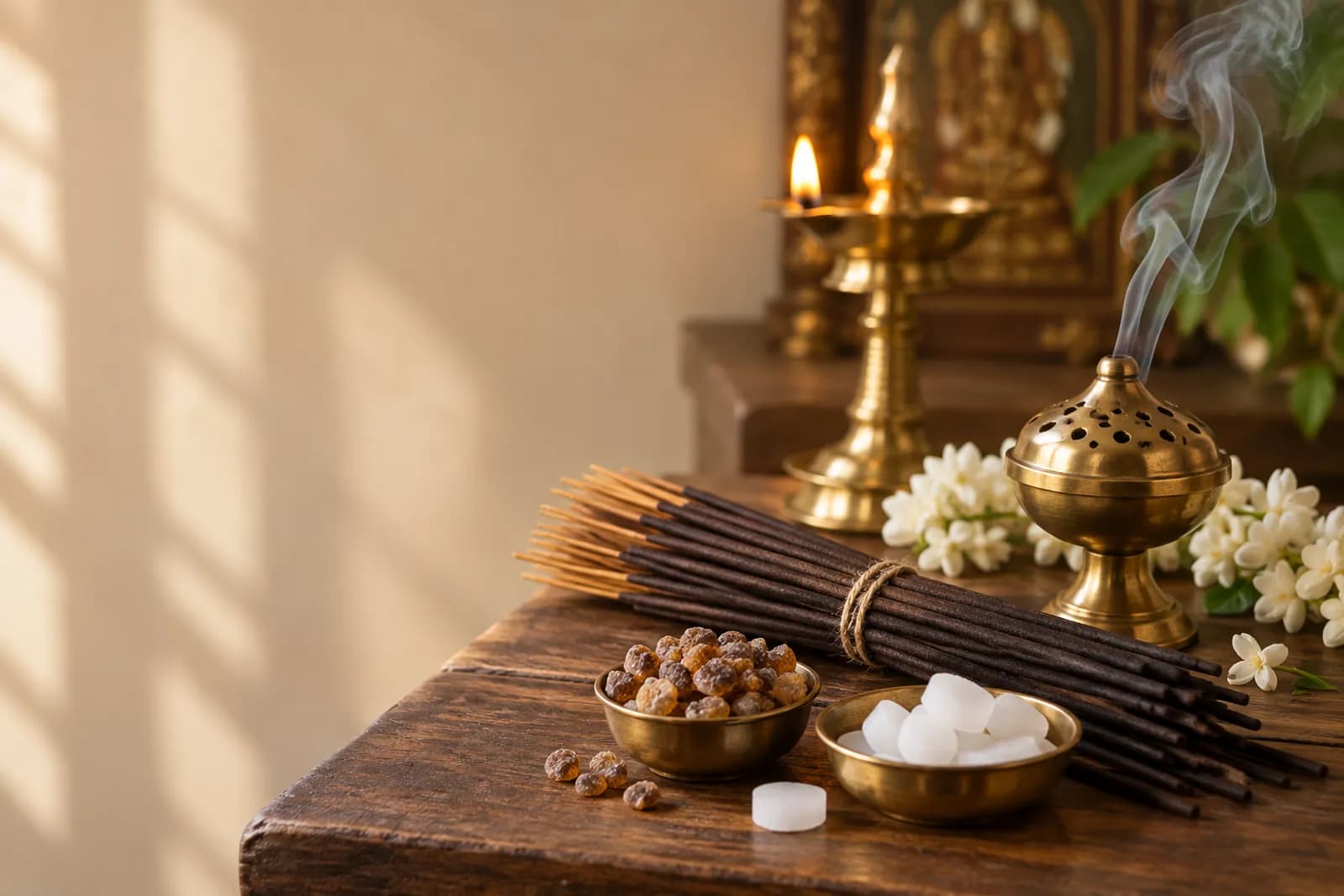
Sambrani resin and cups for preparing the room, agarbatti in sandal, jasmine and loban for the dhoopam upachara, bamboo-free dhoop sticks for the aarti, and loban and guggul for purification and the homam. Incense is used at three moments of every pooja — before, during and at the close — and each has its own form. What to use when is below.
Incense enters a pooja three times. Before it begins, sambrani — benzoin resin dropped on an ember in a footed cup — is carried through the room and round the deity, and the smoke is fanned over the child's hair in the evening. During the pooja, agarbatti is lit for the dhoopam, the upachara of fragrance, and waved before the deity. At the harathi, dhoop — the thick stick or cone — burns beside the camphor. Loban and guggul, the harder resins, are used for purification at a Gruha Pravesham and go into the havan samagri of a homam.
Bazaar incense is often charcoal and perfume on a bamboo splint. These are the traditional forms: sambrani that is benzoin resin, agarbatti rolled on a natural base in sandal, jasmine and loban, dhoop without bamboo, and loban and guggul as the raw resin. All are here in pack sizes from a month's daily pooja to a festival.
In this category
What we stock in Incense & Fragrance
Packs of 20 and 100
Agarbatti
Sandal, jasmine and loban sticks.
Sandalwood, jasmine and loban agarbatti rolled on a natural base without charcoal, for the dhoopam upachara. A pack of 20 is a fortnight of daily pooja; the pack of 100 serves a festival or a month of twice-daily lamps.
50g packs, or cups
Sambrani
Benzoin resin and the cups, with the holder.
Benzoin resin in the loose form for dropping on an ember, and the pressed cup that lights on its own, with the brass holder to carry it round the room. The cups are the simplest way to prepare the room before a pooja.
Packs of 12
Dhoop Sticks
Bamboo-free dhoop for the aarti.
Thick bamboo-free dhoop sticks that burn slowly beside the harathi and through a long pooja, in sandal and loban. A pack of 12 serves a festival week.
100g packs
Loban & Guggul
For the dhoopam offering and for purification.
Loban (benzoin) and guggul resin for dhoopam on charcoal — the purification of a new house at Gruha Pravesham, the evening fumigation, and as an ingredient of havan samagri. In 100g packs.
Sizes and pack quantities vary by supplier and season. Fresh items — flowers, mango leaves, banana stems and tamboolam — are supplied against your ceremony date, so tell us the date when you enquire.
Choosing and using
Before you buy
1
Sambrani before, agarbatti during, dhoop at the close
Prepare the room with sambrani smoke, offer agarbatti at the dhoopam upachara, and burn dhoop beside the harathi. One pooja can use all three; a daily pooja uses agarbatti alone.
2
Cups for convenience, resin for tradition
The pressed sambrani cup lights with a match and burns for ten minutes; loose resin on a charcoal ember is the older form and gives more smoke for a Gruha Pravesham.
3
Choose the fragrance by the deity
Sandal for Shiva and the daily pooja, jasmine for Devi and Lakshmi, loban for purification and the pitru rites. Ask and the pack comes in the fragrance the pooja calls for.
4
Ventilate a small pooja room
Sambrani and loban produce a good deal of smoke. Open a window, and in an apartment use the cups rather than the charcoal form.
Common questions
Before you book
What is sambrani and how is it used?
Benzoin resin — gum from the Styrax tree — dropped on a charcoal ember in a footed cup, or pressed into a cup that lights on its own. The smoke is carried through the room before a pooja, round the deity, and over wet hair in the evening.
What is the difference between agarbatti and dhoop?
Agarbatti is the thin stick lit for the dhoopam upachara and waved before the deity; dhoop is the thick bamboo-free stick or cone that burns slowly beside the harathi. A pooja uses both at different moments.
What is loban dhoop used for?
Loban is benzoin in its harder form, burned on charcoal to purify a space — at a Gruha Pravesham, in the evening, and after a pitru rite — and mixed into havan samagri. Guggul, a resin of the Commiphora tree, is used the same way.
Is the agarbatti charcoal-free?
Yes — rolled on a natural base without charcoal, in sandal, jasmine and loban. It burns cleaner and does not blacken the pooja room.
Which incense for a daily pooja?
Sandal agarbatti at the dhoopam, and sambrani in the evening if the family keeps that custom. A pack of 100 agarbatti and a pack of sambrani cups is a month.
How do I order?
Tell us the ceremony date when you enquire. We confirm availability, the final contents and the price before anything is charged; fresh items are supplied against the date.