Homam Service · Hyderabad
Chandi Homam in Hyderabad
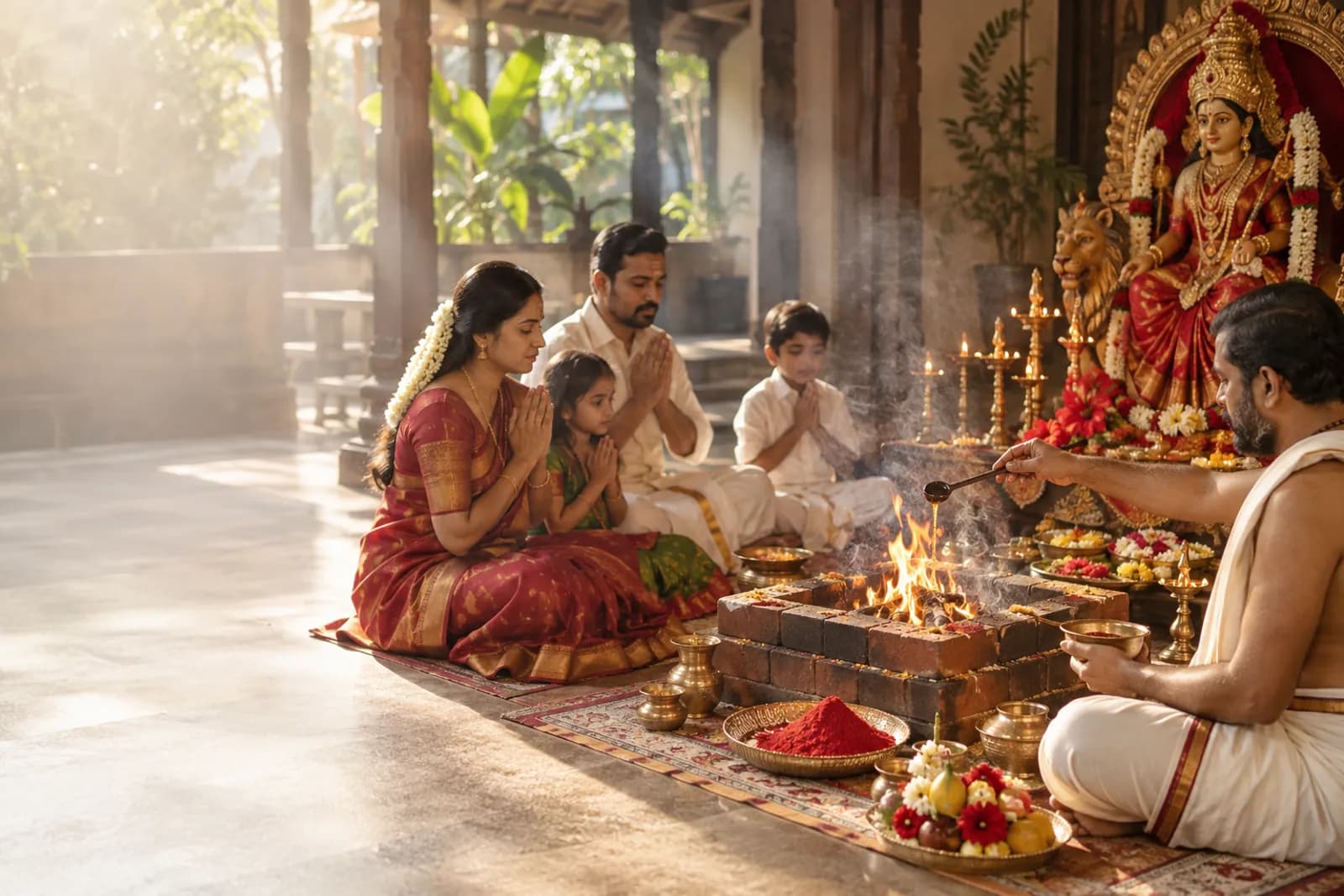
Chandi Homam is a traditional Hindu fire ritual dedicated to Goddess Chandi, with the Devi Mahatmyam (Durga Saptashati) forming an important part of the ritual. The ceremony combines sacred recitation, Devi worship and homam offerings into the fire.
Families may choose Chandi Homam for devotional worship, spiritual protection, overcoming obstacles, auspicious beginnings, Navaratri observances and important family occasions.
Anugraha Siddhi arranges Chandi Homam in Hyderabad with Purohit guidance based on your family's requirements, the occasion, venue and preferred scale of the ritual.
Quick Overview
| Detail | Information |
|---|---|
| Pooja name | Chandi Homam |
| Primary deity | Goddess Chandi / Chandika Devi |
| Scriptural basis | Devi Mahatmyam / Durga Saptashati |
| Ritual type | Vedic or Agamic fire ritual with Devi worship |
| Main recitation | Devi Mahatmyam |
| Common occasions | Navaratri, family occasions, devotional observances and specific sankalpas |
| Performed at | Home, apartment, temple or suitable venue |
| Location | Hyderabad and surrounding areas |
| Priest guidance | Purohit-led ceremony |
| Languages | Telugu, Hindi and English, subject to availability |
| Booking | Call or WhatsApp +91 90320 22323 |
What Is Chandi Homam?
Chandi Homam is a sacred fire ritual performed in devotion to Goddess Chandi, a powerful manifestation of Devi Shakti. A central component of Chandi worship is the recitation of the Devi Mahatmyam, also known as Durga Saptashati or Chandi Path.
The text consists of 13 chapters and 700 verses and describes the glory and victories of Devi in different forms. During Chandi Homam, sacred offerings are made into the homa fire while prescribed mantras and portions of the Devi Mahatmyam are recited.
The exact sequence, number of recitations, number of Purohits and duration can vary according to the tradition and scale of the ceremony. For this reason, families should discuss the intended form of Chandi Homam with the conducting Purohit before finalising the arrangements.
Why Do Families Perform Chandi Homam?
Chandi Homam is primarily a form of Devi worship and spiritual observance. Devotees may perform it with a particular sankalpam or intention.
Families who have devotion toward Devi may perform Chandi Homam as an elaborate form of worship.
Chandi-related worship is particularly associated with Navaratri, when devotees undertake Devi worship, Durga Saptashati recitation and related rituals. Ashtami and Navami are commonly chosen, depending on the family tradition and panchangam.
Devotees may perform the homam as part of their prayers for spiritual protection and well-being.
Some families undertake Chandi Homam when beginning an important phase of life or when seeking divine blessings while dealing with difficulties.
A family may choose Chandi Homam for a significant milestone, sankalpam, religious observance or other auspicious occasion.
For devotees, the primary purpose is to express faith, devotion and surrender to Goddess Chandi while seeking her blessings for the family.
The ritual should be understood as a religious observance rather than as a guaranteed solution to a particular problem.
When Is Chandi Homam Performed?
Chandi Homam can be performed at different times depending on the purpose and family tradition.
Sharad Navaratri and Vasanta Navaratri are important periods for Devi worship. Many devotees prefer Ashtami or Navami for special Devi rituals, although the appropriate date should be determined according to the relevant panchangam and the family's tradition.
Friday is traditionally associated with Devi worship in many Hindu traditions. Some families choose Fridays for Devi-related poojas and homams.
Chandi Homam may also be arranged for a specific family occasion or sankalpam after consultation with the Purohit.
Important: The appropriate date and muhurtham should be finalised according to the family's tradition and local panchangam rather than assuming that one date is universally suitable.
Chandi Homam Procedure
The exact procedure can differ according to the sampradaya and the scale of the ceremony. A typical household Chandi Homam may include the following stages.
Preparation of the Pooja Space
The designated area is cleaned and arranged for the homam. The homa kundam, pooja items, kalasham, Devi representation and other required materials are arranged before the ceremony begins.
For a long-duration homam, sufficient seating, ventilation and safe fire arrangements should be planned.
Ganapathi Pooja
The ceremony may begin with Ganapathi Pooja to seek the blessings of Lord Ganesha before undertaking the main ritual.
Sankalpam
The Purohit performs the sankalpam according to the family's details and purpose. It may include family members' names, gotram, place, date, ritual intention, the number or type of recitations and the specific family occasion where applicable.
Kalasha Sthapana
A kalasham is prepared and worshipped as part of the Devi ritual. The required items may include the kalasham, water, mango leaves, coconut, turmeric, kumkum, flowers and akshata. The precise arrangement depends on the ritual tradition followed by the Purohit.
Devi Avahanam
Goddess Devi is invoked through prescribed mantras and worshipped according to the ritual procedure. The family participates in the pooja under the guidance of the Purohit.
Devi Mahatmyam Recitation
The Devi Mahatmyam, also called Durga Saptashati, forms the central scriptural component of Chandi worship. It contains 13 chapters and 700 verses.
Traditional Chandi worship may also include associated recitations such as Devi Kavacham, Argala Stotram, Keelakam, Ratri Suktam, Devi Suktam and Rahasya portions. The exact recitations included should be confirmed with the conducting Purohit.
Chandi Homam
The sacred fire is established in the homa kundam. Offerings such as ghee and prescribed homam materials are offered into the fire while the relevant mantras and recitations are performed. This is the principal fire-ritual portion of Chandi Homam.
Purnahuti
The ceremony concludes with Purnahuti, the final and complete offering into the sacred fire. Family members participate according to the Purohit's instructions.
Kanya Pooja and Suvasini Pooja
Depending on the tradition and arrangement, Kanya Pooja and Suvasini Pooja may be performed as part of the concluding Devi worship. These are associated with honouring feminine forms of Devi.
Whether they are included in a particular Chandi Homam should be confirmed during booking.
Mangala Harathi and Prasadam
The ceremony concludes with Mangala Harathi, Devi prayers, blessings from the Purohit and distribution of prasadam. The family receives the concluding blessings after completion of the homam.
Chandi Homam Mantras
Chandi worship includes several traditional mantras and recitations. One of the well-known mantras associated with Chandi worship is the Navakshari Mantra:
Om Aim Hreem Kleem Chamundayai Vichche
The Devi Mahatmyam also contains several widely recited Devi stotras and prayers. For the actual homam, the family should follow the mantras and recitation sequence prescribed by the conducting Purohit rather than attempting to independently construct the ritual.
Chandi Homam Samagri
The exact samagri list depends on the type and scale of Chandi Homam. Common requirements may include:
- Homa kundam
- Homa wood / samidha
- Ghee
- Havan samagri
- Black sesame
- Rice / akshata
- Turmeric
- Kumkum
- Sandalwood
- Flowers
- Red cloth
- Coconut
- Betel leaves
- Betel nuts
- Fruits
- Kalasham
- Mango leaves
- Camphor
- Incense
- Cotton wicks
- Oil / ghee for lamps
- Devi picture, idol or yantra where applicable
- Naivedyam
- Dakshina
Additional items may be required for Kanya Pooja, Suvasini Pooja and larger Chandi forms. The Chandi Homam Kit covers the common materials once the final list is confirmed.
Who Arranges the Samagri?
Before booking, ask whether the selected package includes:
- Pooja samagri
- Homam samagri
- Flowers
- Fruits
- Homa kundam
- Priest dakshina
- Travel charges
- Naivedyam
- Kanya Pooja requirements
This prevents last-minute confusion.
Chandi Homam at Home
A household Chandi Homam may be conducted at home if adequate arrangements can be made for the fire ritual and participating Purohits. Before choosing a home ceremony, consider:
- Available space
- Ventilation
- Fire safety
- Seating arrangements
- Number of Purohits
- Duration of the ritual
- Availability of water
- Food arrangements
- Samagri storage
- Building or apartment fire-safety rules
For apartments, it is particularly important to confirm whether the society permits a homam involving an open sacred fire. If your home does not have sufficient space, a suitable hall or temple venue may be more practical.
Chandi Homam at a Hall or Temple
A hall may be suitable for larger Chandi Homam arrangements. It can provide additional space for:
- Multiple Purohits
- Family members
- Homa kundam
- Seating
- Kanya Pooja
- Food arrangements
- Larger quantities of samagri
For Nava Chandi or larger forms, the space and priest requirements can increase considerably. The venue should therefore be finalised only after discussing the scale of the ceremony with the Purohit.
Chandi Homam vs Durga Homam
Although both are Devi-related fire rituals, they are not necessarily identical.
| Chandi Homam | [Durga Homam](/homams/durga-homam) |
|---|---|
| Associated with Goddess Chandi / Chandika | Dedicated to Goddess Durga |
| Devi Mahatmyam is central to the Chandi tradition | May follow a different mantra and ritual sequence |
| Includes Chandi-related recitation | Procedure depends on the specific Durga Homam tradition |
| Can be an elaborate and lengthy ritual | Duration varies by ritual format |
| May involve Chandi Path / Durga Saptashati | Does not necessarily require complete Devi Mahatmyam recitation |
If you specifically want the Devi Mahatmyam-based Chandi ritual, mention this clearly while booking.
Chandi Homam, Nava Chandi and Shata Chandi
The term “Chandi” can refer to different scales of ritual. A commonly described distinction is based on the number of complete Devi Mahatmyam recitations.
| Form | Complete recitations |
|---|---|
| Chandi Homam | 1 |
| Nava Chandi | 9 |
| Shata Chandi | 100 |
| Sahasra Chandi | 1,000 |
The priest count, duration, venue and overall arrangements can change substantially as the scale increases.
When requesting a quotation, don't simply say “Chandi Homam”. Ask the Purohit to specify the exact form, number of recitations and inclusions.
Who Can Perform Chandi Homam?
Chandi Homam involves detailed recitations and a prescribed ritual sequence. It is therefore generally performed under the guidance of a qualified Purohit familiar with the relevant Devi worship tradition.
The family does not need to know every mantra beforehand. The Purohit guides participants throughout the ceremony and explains when they need to:
- Offer samagri
- Perform sankalpam
- Participate in the pooja
- Make offerings
- Join the final prayers
Chandi Homam for Navaratri
Navaratri is one of the most significant periods for Devi worship. Families may choose Chandi Homam during Navaratri as part of their devotional observance.
Depending on the family's tradition, the ceremony may be planned around Ashtami, Navami, Vijayadashami or another suitable Navaratri day. Navaratri is a high-demand period for Devi rituals. Families planning a Chandi Homam should discuss the date, Purohit availability and samagri requirements in advance.
Planning for Navaratri? Dates and Purohits go early in that window, so the enquiry is worth making well before the festival.
Chandi Homam in Hyderabad
Anugraha Siddhi provides Purohit services for families looking to arrange Chandi Homam in Hyderabad. Service arrangements can be discussed for locations including:
- Kukatpally
- Miyapur
- KPHB
- Nizampet
- Bachupally
- Hyder Nagar
- Pragathi Nagar
- Hitech City
- Gachibowli
- Kondapur
- Manikonda
- Madhapur
- Other Hyderabad locations
Availability depends on the date, venue and Purohit requirements.
Office address
Metro Pillar No: A689, Dr Atmaram Estates,3rd Floor, Nizampet X Roads,
beside Sri Bhramaramba Theatre, near Jntu Metro Station,
Hyderabad, Telangana 500072
Why Choose Anugraha Siddhi for Chandi Homam?
The ceremony is conducted with Purohit guidance so that the family can participate without needing prior knowledge of the complete procedure.
Requirements can be discussed according to your occasion, family tradition, preferred date, venue, number of participants and ritual scale.
Anugraha Siddhi serves families across Hyderabad and surrounding areas, subject to availability.
You can clarify the required samagri and understand which items are included in the service arrangement before confirming the booking.
Depending on the scale and venue suitability, Chandi Homam can be planned at a home or another appropriate location.
Before confirming, families can discuss the expected duration, priest count, samagri, dakshina, venue requirements and other inclusions.
Chandi Homam Cost in Hyderabad
There is no single fixed price for every Chandi Homam. The total cost can depend on:
- Type of Chandi Homam
- Number of recitations
- Number of Purohits
- Duration
- Venue
- Pooja and homam samagri
- Flowers and fruits
- Naivedyam
- Kanya Pooja arrangements
- Priest dakshina
- Travel charges
- Food arrangements
- Additional rituals requested by the family
For example, a simple household Chandi Homam and a larger Nava Chandi ceremony should not be expected to have the same requirements. Contact Anugraha Siddhi for a requirement-based quotation.
How to Book Chandi Homam with Anugraha Siddhi
Booking can be kept simple.
Contact Us
Call or WhatsApp +91 90320 22323.
Share Your Requirements
Provide the preferred date, location, occasion, number of family members, preferred form of Chandi ritual and whether the venue is a home, hall or temple.
Discuss the Ritual
The Purohit can guide you regarding the procedure, muhurtham, priest requirements, samagri, duration, Kanya Pooja and other arrangements.
Confirm the Booking
Once the date, venue and requirements are finalised, confirm the service.
Prepare for the Ceremony
Follow the preparation instructions provided by the Purohit and keep the required space and materials ready.
Frequently Asked Questions
What is Chandi Homam?
Chandi Homam is a sacred fire ritual dedicated to Goddess Chandi and traditionally associated with the recitation of the Devi Mahatmyam, also known as Durga Saptashati or Chandi Path. Sacred offerings are made into the homam fire while prescribed prayers and mantras are recited.
Why is Chandi Homam performed?
Devotees perform Chandi Homam as a form of Devi worship and may undertake it for spiritual protection, overcoming obstacles, important family occasions, Navaratri observances or a specific sankalpam.
How long does Chandi Homam take?
The duration varies according to the form of the ritual, number of recitations, number of Purohits and additional ceremonies. A full household Chandi Homam can occupy a substantial part of the day.
Can Chandi Homam be performed at home?
Yes, a suitable Chandi Homam may be performed at home if there is sufficient space, ventilation and a safe arrangement for the homam fire. Apartment rules and fire-safety requirements should also be checked beforehand.
Can Chandi Homam be performed during Navaratri?
Yes. Navaratri is an important period for Devi worship, and many devotees choose this period for Chandi-related rituals. The exact date should be finalised according to the family's tradition and panchangam.
What is the difference between Chandi Homam and Nava Chandi?
The terms commonly distinguish the scale based on the number of complete Devi Mahatmyam recitations. Chandi Homam refers to one complete recitation, while Nava Chandi refers to nine. The exact arrangement should be confirmed with the conducting Purohit.
What samagri is required for Chandi Homam?
Common items include ghee, homam samagri, samidha, flowers, fruits, coconut, turmeric, kumkum, kalasham items, lamps and other pooja materials. The final list depends on the ritual format and should be obtained from the Purohit.
Can families participate in Chandi Homam?
Yes. Family members can participate under the guidance of the Purohit. The Purohit will explain when to perform sankalpam, make offerings and participate in the concluding rituals.
Can I book Chandi Homam in Hyderabad with Anugraha Siddhi?
Yes. You can contact Anugraha Siddhi to discuss Chandi Homam arrangements in Hyderabad, including the preferred date, venue, ritual requirements and Purohit availability.
How can I book Chandi Homam with Anugraha Siddhi?
Call or WhatsApp +91 90320 22323 and share your preferred date, location and requirements. The service team can guide you regarding the ritual format, Purohit arrangements, samagri and other requirements.
Book Chandi Homam in Hyderabad
Perform your Chandi Homam with proper Purohit guidance and a clearly planned ritual arrangement. Whether you are planning it for Navaratri, a family occasion, a devotional sankalpam or an important milestone, Anugraha Siddhi can help you understand the ritual requirements and arrange the ceremony according to your needs.