
Traditional Pooja Services · Hyderabad
Pithru Tharpanam in Hyderabad
Remembering our ancestors is an important part of Hindu tradition. Pithru Tharpanam is a traditional ancestral offering performed to express respect, remembrance and gratitude towards departed family members. Also referred to as Pitru Tarpan, this observance commonly involves offering water according to the family's religious customs. Families may consider Amavasya Pitru Tharpanam, observances during Pitru Paksha, or a particular ancestral remembrance day based on their tradition.
A Pitru Tharpanam Pooja may be arranged when a family wishes to observe the ritual with the guidance of a Purohit who understands the relevant customs and procedure. The exact method, materials, mantras and timing can differ according to family tradition, regional practice and sampradaya.
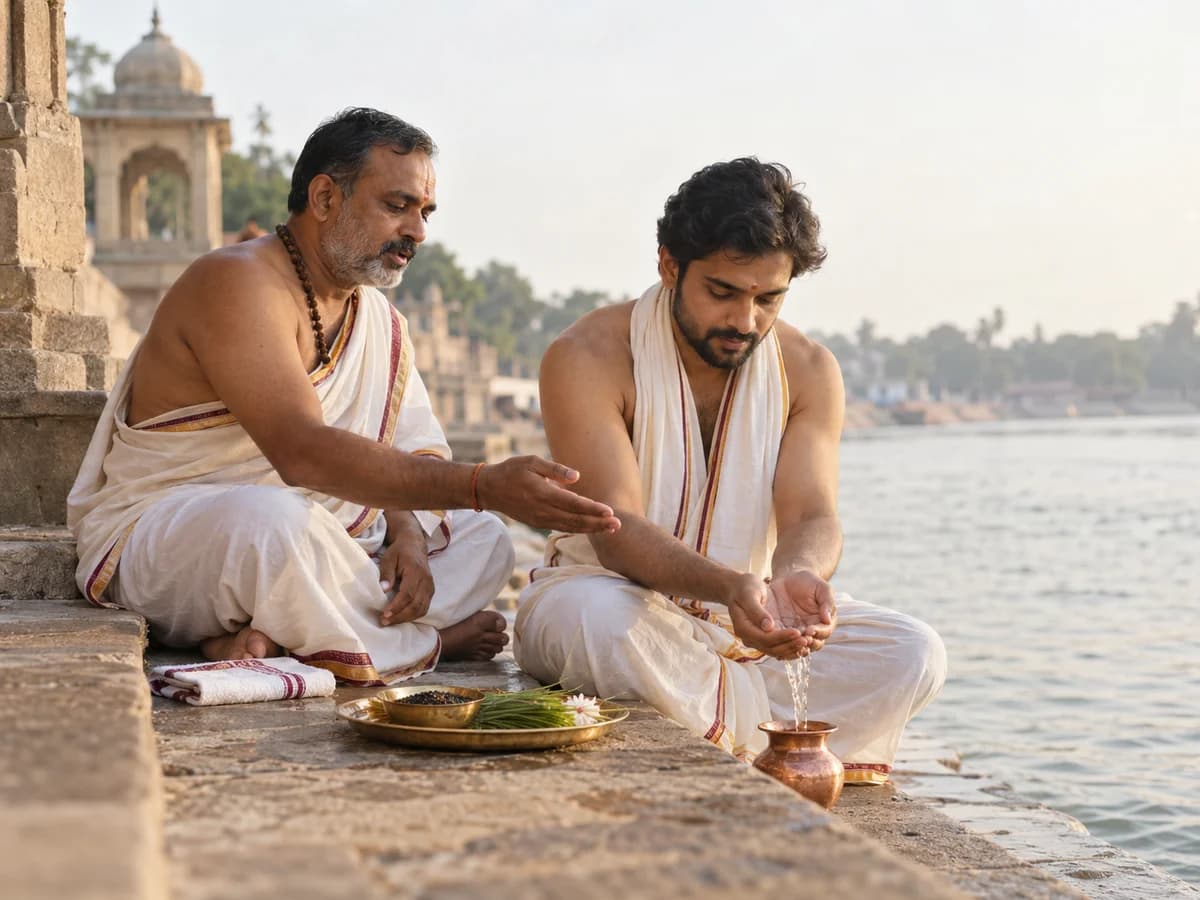
Pithru Tharpanam Service Overview
At Anugraha Siddhi, families in Hyderabad can discuss their Pithru Tharpanam requirements and receive guidance on planning the observance according to their traditional practices. With 5+ years of experience and consultation support in Telugu and English, the focus is on respectful arrangements and clear communication about the ceremony.
Call or WhatsApp 9032022323 to discuss Pithru Tharpanam in Hyderabad.
Quick Overview
Pithru Tharpanam at a Glance
| Detail | Information |
|---|---|
| Service | Pithru Tharpanam |
| Also Known As | Pitru Tarpan |
| Main Purpose | Traditional remembrance of departed ancestors |
| Common Observance | Amavasya, Pitru Paksha and other family-prescribed occasions |
| Ceremony Format | Depends on family tradition and the selected requirements |
| Guidance | Experienced Purohit, subject to service arrangements |
| Location | Hyderabad, Telangana |
| Language Support | Telugu and English |
| Booking | Discuss the date, tradition and requirements in advance |
What Is Pithru Tharpanam?
Pithru Tharpanam is a traditional Hindu ritual associated with offering water to departed ancestors. The practice is connected with Pitru—ancestors—and Tarpanam, an offering traditionally understood as an act of honouring or satisfying the recipients of the offering.
For many families, the observance is an expression of gratitude towards parents, grandparents and earlier generations. It provides a formal way to remember family members who have passed away and continue an inherited religious practice.
The ceremony may involve prayers, a sankalpa or statement of intention, water offerings and other traditional elements. The prescribed procedure is not identical for every family. Some lineages follow specific mantras, offerings and ritual sequences, while others follow a different customary method.
For this reason, it is useful to explain your family tradition before finalising arrangements rather than assume that one universal procedure applies to everyone.
Why Do Families Perform Pitru Tarpan?
Families may observe Pitru Tarpan for several traditional and personal reasons.
To Remember Departed Family Members
The ritual creates a specific occasion for remembering ancestors and acknowledging their place in the family.
To Continue Family Tradition
Some families observe ancestral rites regularly, while others arrange them on particular lunar dates or during specific periods of the Hindu calendar.
To Observe Religious Duties
In many Hindu traditions, honouring ancestors is considered an important family and religious responsibility. The way this responsibility is observed varies among communities and lineages.
To Mark an Important Ancestral Date
A family may arrange Pithru Tharpanam on Amavasya, during Pitru Paksha, or in connection with a death-anniversary observance, depending on its customs.
To Perform the Ritual With Guidance
Families who are unfamiliar with the mantras or procedure may prefer to consult a knowledgeable Purohit rather than improvise the ceremony.
These are traditional and devotional reasons for the observance. The ritual should be approached respectfully, without treating it as a guaranteed solution to personal, financial, family or health difficulties.
What Is the Difference Between Pithru Tharpanam, Pitru Tarpan and Shraddha?
The terms can overlap in everyday discussion, but they do not necessarily describe exactly the same ritual.
| Term | General Meaning |
|---|---|
| Pithru Tharpanam | Traditional offering associated with remembering departed ancestors |
| Pitru Tarpan | An alternative spelling commonly used for Pitru Tarpanam |
| Pitru Tharpanam Pooja | A general expression families may use when referring to an arranged ancestral offering or ceremony |
| Shraddha | A broader ancestral rite that may include prescribed offerings and other ritual elements |
| Pinda Daan | A distinct offering-based observance associated with ancestral rites in certain traditions |
| Pitru Paksha | A period in the Hindu lunar calendar associated with ancestral remembrance and rites |
The scope of a ceremony depends on the tradition followed. Pithru Tharpanam should not automatically be assumed to include a complete Shraddha ceremony, Pinda Daan, food offerings, charitable donations or other additional rites.
When discussing your booking, explain which observance your family intends to perform.
When Is Pithru Tharpanam Performed?
There is no single date that applies to every family's ancestral observance. The relevant date depends on the occasion, lunar calendar, family custom and ritual tradition.
1. Amavasya
Amavasya Pitru Tharpanam refers to ancestral offerings performed in connection with Amavasya, the new-moon lunar day.
Many Hindu families associate Amavasya with remembering and honouring ancestors. The particular Amavasya observed, the preferred time and the required procedure should be confirmed according to the relevant Panchang and family tradition.
2. Pitru Paksha
Pitru Paksha is a traditional period dedicated to ancestral remembrance and rites. Families may observe Tarpanam or other prescribed rituals during this period.
The appropriate lunar date and procedure can depend on the family's customs and the circumstances of the ancestor being remembered.
3. Annual Death Anniversary
Some families observe ancestral rites on the lunar date associated with a departed family member's passing. This may involve a prescribed Shraddha or another family-specific observance, with Tarpanam performed as part of the wider tradition where applicable.
4. Other Family-Prescribed Occasions
Certain families follow additional observances prescribed by their lineage, religious tradition or family Purohit.
Before choosing a date, explain the intended occasion so that the correct ritual requirements can be discussed.
Amavasya Pitru Tharpanam: What Should You Know?
Amavasya Pitru Tharpanam is one of the main occasions families may consider for ancestral remembrance.
However, not every Amavasya observance is necessarily identical. The relevant lunar month, the family's tradition, the intended purpose and the local Panchang may influence the date and procedure.
Before arranging the ceremony, confirm the following:
- Which Amavasya is relevant to your observance?
- Is the ceremony intended for a particular ancestor or for a broader ancestral remembrance?
- Does your family follow a particular ritual method?
- Is there a preferred time based on your family's custom?
- Are any additional ancestral rites required?
- What materials and arrangements are actually needed?
If you are planning the ceremony for an upcoming Amavasya, contact the Purohit in advance. Confirm the date and timing against the appropriate local Panchang rather than relying on a generic calendar entry.
Important: Amavasya Pitru Tharpanam should not automatically be treated as interchangeable with every form of Shraddha or Pinda Daan.
How Do You Choose the Correct Date?
The date should be selected according to the reason for the observance.
For example, the considerations may differ if you are arranging:
- Amavasya Pitru Tharpanam
- A Pitru Paksha observance
- A ritual associated with an annual death anniversary
- A family-specific ancestral ceremony
The information you provide will help determine which traditional calendar details need to be checked.
A useful planning sequence is:
Occasion → Relevant lunar date → Family tradition → Required ceremony → Timing → Arrangements
If the exact ancestral date is unknown, mention that when seeking guidance. Do not assume that the same date or procedure is suitable in every situation.
What May Be Required for Pithru Tharpanam?
The required materials vary according to the ritual method followed. A traditional arrangement may involve some of the following items:
| Material | Traditional Context |
|---|---|
| Clean water | Commonly used for the Tarpanam offering |
| Black sesame seeds | Used in many ancestral-rite traditions |
| Darbha or Kusha grass | Used in certain traditional procedures |
| Suitable vessel | Used to hold or offer water |
| Flowers | Included where prescribed by the family's practice |
| Sacred thread or other ritual items | Required in certain traditions and circumstances |
This table is a general guide, not a universal Samagri list. Do not purchase or prepare every item automatically.
Ask which materials are actually required for your specific observance and who is expected to arrange them.
Does Pithru Tharpanam Require a Purohit?
The answer depends on the particular ritual and your family's tradition.
Some families maintain their own established Tarpanam practice. Others prefer the guidance of a Purohit, particularly when performing a formal observance or when the procedure is unfamiliar.
Purohit guidance may be especially useful when:
- You are arranging the ritual for the first time.
- Your family follows specific mantras or ritual rules.
- You are unsure which lunar date is relevant.
- You need to distinguish Tarpanam from a broader Shraddha ceremony.
- You want to clarify the required materials and sequence.
When discussing the service with Anugraha Siddhi, explain the occasion and your family's requirements. The available guidance and arrangements should be confirmed before booking.
Can Pithru Tharpanam Be Performed at Home?
A home observance may be appropriate for some families, depending on their tradition and the specific ritual being performed.
Before planning a home ceremony, consider:
- Whether your family custom permits the intended observance at home
- Whether a Purohit's guidance is required or preferred
- Whether a clean and suitable place can be arranged
- Whether specific vessels or materials are prescribed
- Whether the family follows a particular direction, mantra or ritual sequence
- Whether other rites need to accompany Tarpanam
The home arrangement should follow the relevant traditional method. A generic online instruction should not replace family-specific guidance when prescribed procedures differ.
Pithru Tharpanam During Pitru Paksha
Pitru Paksha is associated with remembering departed ancestors through traditional rites. Families may choose to observe Tarpanam during the period according to their customs.
The planning process should begin by confirming the relevant tithi and the specific observance expected by the family.
Questions to clarify include:
- Which ancestral tithi is relevant?
- Is Tarpanam the intended service, or is a broader Shraddha ritual required?
- Does the family have established practices or instructions from its Purohit?
- Is there a preferred date and time?
- Are additional offerings or arrangements needed?
These details help prevent confusion between different ancestral rites and ensure that the booking matches the family's actual requirements.
What If You Do Not Know the Ancestor's Exact Tithi?
Families may not always know the exact lunar date associated with an ancestor's passing.
In such cases, explain what information is available, such as the approximate date of passing, the family member being remembered and any existing family custom.
The appropriate observance should be determined with reference to the family's tradition and relevant Panchang. A particular Amavasya observance may be considered in some traditions, but the correct approach should not be assumed without checking the circumstances.
If you are uncertain whether to arrange Tarpanam, Shraddha or another rite, mention that uncertainty at the beginning of the consultation.
What Is Included in a Pitru Tharpanam Pooja?
The term Pitru Tharpanam Pooja may be used broadly by families seeking help arranging an ancestral ritual.
However, the name alone does not establish what a particular ceremony includes.
Depending on the agreed requirements, the arrangement may involve discussion of the occasion, date, traditional procedure, materials and Purohit guidance. Additional rituals must be confirmed separately.
Before booking, ask whether your requested service includes:
- The specific Tarpanam observance
- Preparation or arrangement of Samagri
- Any additional Shraddha rites
- Pinda Daan, if required
- Food offerings or other prescribed observances
- The preferred venue and time
- Any other family-specific requirements
Anugraha Siddhi can discuss these requirements with you and confirm the available arrangements. Do not assume that extra rituals, materials or offerings are automatically included.
What Information Should You Share Before Booking?
Providing clear information at the start helps the service discussion stay focused.
Information About the Occasion
Explain whether you need Amavasya Pitru Tharpanam, a Pitru Paksha observance, an annual death-anniversary rite or another ancestral ceremony.
Relevant Ancestral Details
Share the information requested for the chosen ritual. This may include the name or relationship of the departed family member and the lunar date associated with the passing, if known.
Family Tradition
Mention any established family custom, mantra tradition or instructions you have received from a family Purohit.
Date and Venue
Share your preferred date and whether you are considering a home observance or another suitable location. The final date and venue depend on the specific requirement and confirmed arrangements.
Additional Rituals
Explain whether you require only Tarpanam or want to discuss other rites as well.
You do not need to know every ritual detail before making an enquiry. The purpose of the initial discussion is to clarify the requirements.
Common Mistakes to Avoid
Assuming Every Ancestral Rite Is the Same
Tarpanam, Shraddha and Pinda Daan may be connected, but they are not automatically interchangeable. Confirm the actual service required.
Selecting a Date Without Checking the Tradition
Lunar dates and timing can depend on the local Panchang and family custom. Verify these details before finalising the observance.
Following Unverified Ritual Instructions
Online explanations may describe one tradition without covering the procedure followed by your family. Seek appropriate guidance when unsure.
Assuming Every Material Is Mandatory
Samagri requirements can vary. Confirm the actual list for your particular ceremony.
Assuming a Larger Ceremony Is Always Necessary
The appropriate observance depends on the family's custom and the intended ritual. Avoid adding ceremonies based on fear or unsupported claims.
Expecting Guaranteed Results
Pithru Tharpanam is a traditional religious observance. It should not be advertised as a guaranteed way to remove every problem, resolve financial difficulties or ensure a particular life outcome.
How to Plan Your Pithru Tharpanam
Use this simple preparation framework before confirming arrangements.
| Planning Stage | What to Do |
|---|---|
| Identify the purpose | Clarify the occasion and the ancestor or ancestors being remembered |
| Confirm the tradition | Share the family's established practice, if known |
| Check the date | Confirm the relevant tithi and timing with appropriate guidance |
| Clarify the ceremony | Establish whether Tarpanam alone or additional rites are required |
| Confirm materials | Ask for the Samagri list that applies to your observance |
| Finalise arrangements | Confirm venue, timing, service availability and inclusions |
| Prepare family details | Keep the necessary information ready for the ceremony |
A clear conversation before the observance helps families plan respectfully without making assumptions about the ritual.
Why Choose Anugraha Siddhi for Pithru Tharpanam?
Anugraha Siddhi provides traditional Hindu ritual and astrology-related service arrangements in Hyderabad. Families seeking Pithru Tharpanam can discuss their intended observance and clarify the details before booking.
Our Approach
- 5+ years of experience
- Guidance for traditional Hindu ritual requirements
- Discussion of the occasion and family custom
- Clear communication about the requested ceremony
- Telugu and English language support
- Requirements-based planning
- Confirmation of available arrangements before booking
The ceremony should be planned around the family's actual tradition and requirement, rather than assuming that a single procedure suits every household.
Frequently Asked Questions
1. What is Pithru Tharpanam?
Pithru Tharpanam is a traditional Hindu ancestral offering commonly associated with offering water in remembrance of departed ancestors. The method varies according to family and religious tradition.
2. Is Pithru Tharpanam the same as Pitru Tarpan?
The terms are commonly used for the same broad ancestral offering. Spelling and pronunciation vary, while the prescribed procedure may differ between traditions.
3. What is Amavasya Pitru Tharpanam?
Amavasya Pitru Tharpanam refers to ancestral Tarpanam performed in connection with Amavasya. The appropriate date, timing and procedure should be confirmed according to the family's tradition and relevant Panchang.
4. What is a Pitru Tharpanam Pooja?
It is a term families may use when enquiring about arrangements for an ancestral Tarpanam observance. The exact ritual scope and inclusions should be confirmed before booking.
5. When should Pithru Tharpanam be performed?
The occasion can depend on family tradition. Some families observe it on Amavasya, during Pitru Paksha or on a date associated with an ancestor's passing. Confirm the appropriate occasion for your requirements.
6. Is Pithru Tharpanam performed during Pitru Paksha?
Many families perform ancestral rites during Pitru Paksha. The particular tithi and ritual method depend on the relevant tradition.
7. Can Pithru Tharpanam be performed at home?
A home observance may be appropriate in some traditions. Confirm the procedure, venue requirements and whether Purohit guidance is required for your chosen ritual.
8. Which materials are required for Pithru Tharpanam?
Water and black sesame seeds are used in many traditional forms of Tarpanam. Other materials, such as Darbha or Kusha grass, may be required depending on the prescribed method. Confirm the actual Samagri list with the Purohit.
9. Can I perform Pithru Tharpanam if I do not know the exact death tithi?
Explain what information you have. The appropriate observance should be discussed with reference to family tradition and the relevant Panchang rather than assuming a date automatically applies.
10. Is Pithru Tharpanam different from Shraddha?
They are related ancestral observances, but they are not necessarily identical. Shraddha may involve a broader set of prescribed rites. Confirm the specific ritual your family requires.
11. Does Pithru Tharpanam automatically include Pinda Daan?
No. Pinda Daan is a distinct offering-based observance and should not be assumed to be included in a Tarpanam arrangement. Confirm additional requirements before booking.
12. Can I arrange Amavasya Pitru Tharpanam in Hyderabad?
You can contact Anugraha Siddhi to discuss your requirements in Hyderabad. The date, procedure and service availability should be confirmed before arrangements are finalised.
13. Should I follow my family's traditional procedure?
Where your family has an established practice, share it during the enquiry and seek appropriate guidance. Procedures can vary, so a generic method should not automatically replace the family's prescribed tradition.
14. Does Pithru Tharpanam guarantee the removal of Pitru Dosha or other difficulties?
No specific result should be guaranteed. The ritual is a traditional religious observance associated with remembering and honouring ancestors, not a guaranteed solution to personal, financial or health concerns.
15. How can I enquire about a Pitru Tharpanam Pooja?
Contact Anugraha Siddhi and share the intended occasion, preferred date, family tradition and any additional rituals you may require. The available arrangements and inclusions can then be discussed.
Arrange Pithru Tharpanam in Hyderabad
If your family is planning Pithru Tharpanam, Pitru Tarpan, Amavasya Pitru Tharpanam or a Pitru Tharpanam Pooja, Anugraha Siddhi can help you discuss the traditional requirements and available arrangements.
Explain the occasion, share the details you know and mention whether your family follows a specific ritual method. The service discussion can then focus on the ceremony you actually require.
Anugraha Siddhi
Address: Metro Pillar No A689, JNTU Metro Station, 3rd Floor, Dr Atmaram Estates, beside Sri Bhramaramba Theatre, Hyder Nagar, Vasantha Nagar, Hyderabad – 500072
Call or WhatsApp: 9032022323
Languages: Telugu and English
Pithru Tharpanam is a traditional religious observance. Ritual methods vary by family and tradition, and the ceremony should not be treated as a guarantee of specific spiritual, financial, health or personal outcomes.