
Parayanam & Vedic Ritual Services · Hyderabad
Hanuman Chalisa Parayanam in Hyderabad
Hanuman Chalisa Parayanam is a devotional recitation of the Hanuman Chalisa, a forty-verse hymn dedicated to Lord Hanuman and traditionally attributed to Goswami Tulsidas. Devotees recite the Hanuman Chalisa as an expression of bhakti, surrender, remembrance of Lord Hanuman and prayer for strength, courage and protection.
For families who wish to perform a structured Hanuman Chalisa Parayanam at home, Anugraha Siddhi can arrange guidance from a Purohit with 5+ years of experience in Hyderabad. The parayanam can be planned according to the family's intention, preferred language and traditional practice.
Hanuman Chalisa Parayanam may be performed as a simple devotional recitation or as a sankalpam-based practice with a specific number of recitations. Depending on the requirement, devotees may choose a regular Hanuman Chalisa Path or a dedicated 108-recitation Hanuman Chalisa Parayanam.
Telugu-speaking families can also receive Telugu guidance regarding the basic procedure, preparation and participation so that everyone in the family can follow the parayanam comfortably.
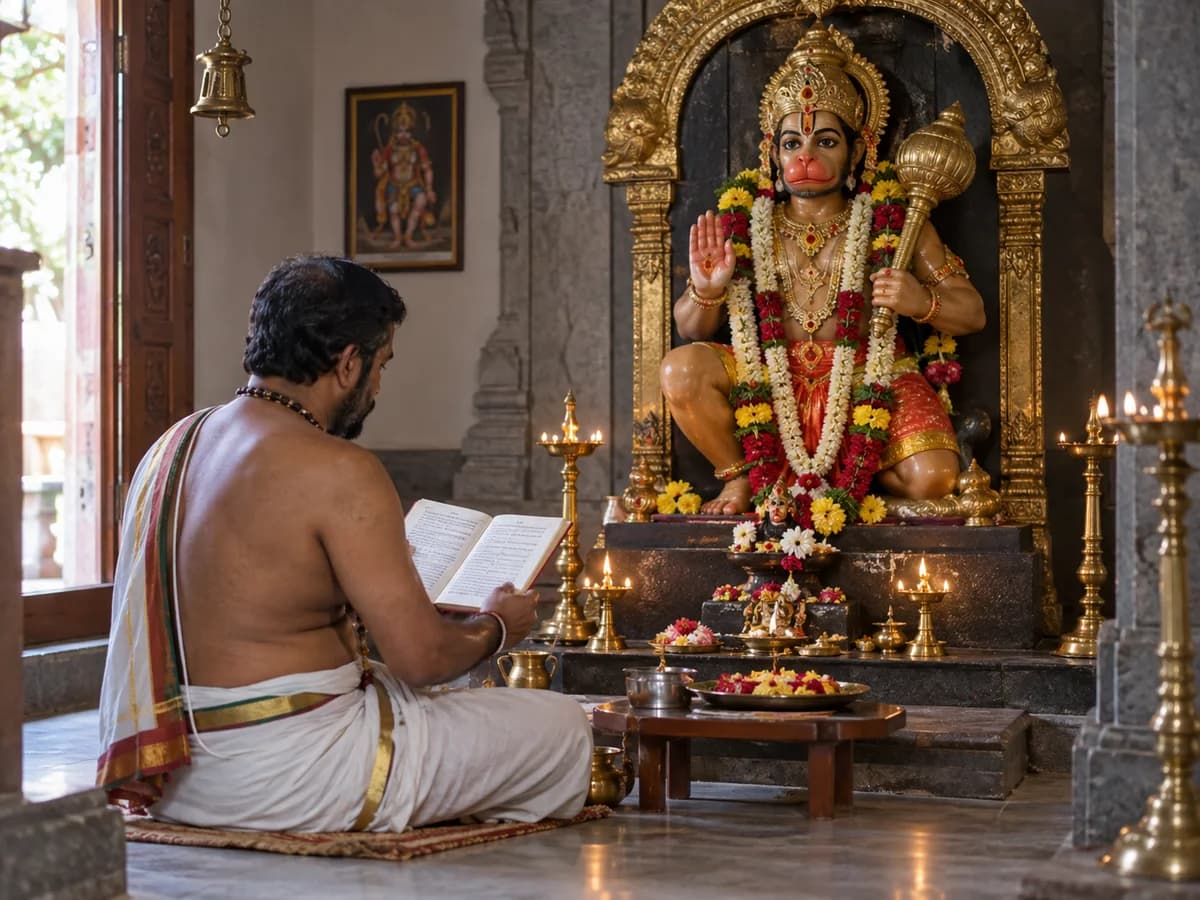
Hanuman Chalisa Parayanam Service in Hyderabad
Discuss your preferred date, location, recitation count, participants and Samagri arrangements before booking. The procedure can follow your family’s devotional tradition.
Quick Overview
| Service | Hanuman Chalisa Parayanam |
|---|---|
| Deity | Lord Hanuman |
| Type of Service | Devotional recitation / Parayanam |
| Also Known As | Hanuman Chalisa Parayan, Hanuman Chalisa Path |
| Location | At home in Hyderabad |
| Language Guidance | Telugu guidance available |
| Recitation Options | Regular recitation and 108-recitation option |
| Suitable Days | Tuesday and Saturday are traditionally preferred by many devotees |
| Participation | Family members can participate according to their comfort |
| Guidance | Purohit with 5+ years of experience |
| Preparation | Basic pooja arrangements and required items can be discussed beforehand |
| Service Area | Hyderabad |
| Booking | Call or WhatsApp 9032022323 |
What Is Hanuman Chalisa Parayanam?
Hanuman Chalisa Parayanam is the devotional practice of reciting the Hanuman Chalisa with attention, faith and reverence toward Lord Hanuman.
The Hanuman Chalisa consists of forty chaupais along with opening and closing dohas. A Hanuman Chalisa Path or Parayanam may be performed individually, with family members or as a group devotional activity. Organised recitation can also include a simple prayer or Hanuman Puja before the Chalisa and aarti after the recitation, depending on the family's chosen tradition.
The purpose of a parayanam is not simply to complete a number of repetitions. For many devotees, the practice is an opportunity to maintain concentration, devotion and remembrance of Lord Hanuman.
A family may choose Hanuman Chalisa Parayanam when they wish to:
- Begin a regular devotional practice
- Offer prayers to Lord Hanuman
- Perform a family prayer at home
- Observe a devotional practice on Tuesday or Saturday
- Undertake a specific sankalpam
- Organise a group Hanuman Chalisa Path
- Perform a dedicated 108-recitation parayanam
- Include children and family members in a traditional devotional activity
The exact procedure and number of recitations can be decided according to the family's intention and customary practice.
Hanuman Chalisa Parayan in Hyderabad
For families living in Hyderabad, performing a Hanuman Chalisa Parayanam at home can provide a convenient way to organise a structured devotional session without having to travel to a temple.
Anugraha Siddhi helps families arrange Hanuman Chalisa Parayanam at home in Hyderabad with guidance from a Purohit with 5+ years of experience.
The service can be suitable for:
- Individual households
- Couples
- Families with children
- Senior family members
- Apartment communities
- Small devotional gatherings
- Families observing a particular sankalpam
- Devotees planning a 108-time Hanuman Chalisa recitation
The family can discuss the preferred form of recitation, language and number of repetitions before the service.
For Telugu-speaking families, the Purohit can provide Telugu guidance so that the family understands the basic steps and knows when and how they can participate.
Hanuman Chalisa Parayanam in Telugu
Many Telugu-speaking families prefer to understand the prayer procedure in Telugu, particularly when elders and children are participating.
Telugu guidance can help the family understand:
- How to prepare the pooja space
- How to begin the parayanam
- How the sankalpam is taken
- How the family can participate
- How the number of recitations is counted
- What basic pooja items may be required
- How the concluding prayer and aarti are performed
The Hanuman Chalisa itself is traditionally a Hindi/Awadhi devotional composition associated with Goswami Tulsidas. It may be recited in the original text while explanations and practical guidance can be provided in Telugu.
If your family follows a particular Telugu devotional tradition, discuss it with the Purohit before the parayanam so the arrangement can be made accordingly.
Hanuman Chalisa Path and Parayan
The terms Hanuman Chalisa Path, Hanuman Chalisa Parayan and Hanuman Chalisa Parayanam are commonly used for organised recitation of the Hanuman Chalisa.
A simple recitation may involve reading the Chalisa once or a chosen number of times. A more structured parayanam may include a sankalpam, devotional preparation, repeated recitation and concluding prayer.
The number of repetitions can vary according to the purpose and family tradition. Some organised Hanuman Chalisa Path practices use counts such as 11, 21 or 108 recitations.
For families specifically looking for a 108 Hanuman Chalisa Parayanam, Anugraha Siddhi can help arrange the recitation according to the service requirement.
108 Hanuman Chalisa Parayanam
A 108-recitation Hanuman Chalisa Parayanam is a dedicated devotional practice in which the Hanuman Chalisa is recited 108 times.
The number 108 has a longstanding place in Hindu devotional and spiritual practices, including mantra and japa traditions. Organised Hanuman Chalisa recitations of 108 times are also performed by devotional groups and families.
The Hanuman Chalisa itself includes the well-known line referring to repeated recitation, which is one reason devotees attach importance to counted recitation. However, interpretations of the spiritual benefits of 108 recitations can differ across traditions.
For this reason, the 108-recitation service should be understood as a devotional practice and sankalpam, rather than as a guaranteed remedy for a particular problem.
A 108-time parayanam may be chosen by devotees who want to undertake a more dedicated period of Hanuman devotion.
How 108 Recitations Can Be Organised
The exact arrangement depends on the family's requirement and the Purohit's guidance.
A typical structure may include:
- Preparing the pooja space
- Invoking Lord Ganesha and Lord Hanuman according to the chosen tradition
- Taking the sankalpam
- Beginning the Hanuman Chalisa recitation
- Maintaining the required count
- Continuing the recitation with concentration and devotion
- Completing all 108 recitations
- Performing the concluding prayer or aarti
The total time required depends on the pace of recitation, participation and the way the 108 recitations are organised.
If you are planning a 108-recitation Hanuman Chalisa Parayanam at home, it is best to discuss the expected duration, number of participants and arrangements with the Purohit beforehand.
Telugu Guidance for Hanuman Chalisa Parayanam
Anugraha Siddhi can provide Telugu guidance for families who prefer instructions in Telugu.
The guidance may cover the practical aspects of the service, including:
Before the Parayanam
Keep the prayer area clean and arrange a suitable place for Lord Hanuman's picture or idol.
Families may prepare commonly used pooja items such as:
- Hanuman image or idol
- Clean cloth
- Flowers
- Kumkum
- Turmeric
- Incense
- Lamp
- Oil or ghee
- Fruits
- Naivedyam
- Akshata
- Water
- Betel leaves and nuts, if followed by family tradition
The exact samagri can vary according to the form of pooja being performed. Therefore, families should confirm the required items before the service rather than assuming that every item is mandatory.
During the Parayanam
Family members can sit comfortably and participate with devotion.
If the family is not familiar with the procedure, the Purohit can guide them through the sequence.
Children can also participate in a simple and age-appropriate manner. They may listen to the recitation, join selected portions or participate in the concluding prayer.
After the Parayanam
The recitation can be followed by a concluding prayer and Hanuman Aarti according to the chosen tradition.
Naivedyam may be offered and distributed as prasadam.
When Is Hanuman Chalisa Parayanam Performed?
Hanuman Chalisa can be recited on any day as a devotional practice.
However, Tuesday and Saturday are traditionally associated with Lord Hanuman, and many devotees prefer these days for Hanuman prayers and Chalisa recitation.
Families may also choose a particular date based on:
- A personal sankalpam
- A family devotional practice
- Hanuman Jayanti
- A religious observance
- A special family occasion
- A period during which they wish to focus on Hanuman devotion
There is no need to choose a particular day solely because someone has promised a guaranteed result. The choice of date can be discussed with the Purohit according to the family's tradition and convenience.
Importance of Hanuman Chalisa Parayanam
The importance of Hanuman Chalisa Parayanam is primarily devotional.
Lord Hanuman is revered in Hindu tradition for qualities such as devotion, courage, strength, discipline, humility and dedicated service to Lord Rama. Reciting the Hanuman Chalisa gives devotees an opportunity to remember these qualities and cultivate a devotional mindset.
For many devotees, regular recitation is associated with:
- Devotion toward Lord Hanuman
- Focus and discipline in prayer
- A sense of inner courage
- Faith during difficult periods
- Regular remembrance of the divine
- Family participation in spiritual practice
These are traditional devotional perspectives and personal spiritual experiences. They should not be understood as guaranteed medical, financial or life outcomes.
Benefits of Hanuman Chalisa Parayanam
Devotees traditionally associate Hanuman Chalisa Parayanam with several spiritual and devotional benefits.
1. Encourages Devotion
Regularly reciting the Hanuman Chalisa provides a structured way to remember Lord Hanuman and express bhakti.
2. Supports a Disciplined Prayer Routine
A fixed recitation practice can encourage consistency in one's spiritual routine.
3. Associated with Courage and Inner Strength
Lord Hanuman is traditionally revered as an embodiment of strength, courage and steadfast devotion. Devotees may therefore recite the Chalisa while praying for courage and inner strength.
4. Provides a Focused Spiritual Practice
Repeating a familiar devotional hymn can help devotees maintain attention during prayer and create a peaceful devotional atmosphere.
5. Encourages Family Participation
A home-based Hanuman Chalisa Parayanam allows family members to come together for prayer.
6. Suitable for a Sankalpam-Based Practice
Families who wish to undertake a particular number of recitations can choose a counted parayanam according to their tradition.
7. Supports Regular Hanuman Worship
For devotees who already worship Lord Hanuman, Chalisa Parayanam can become part of their regular devotional routine.
8. Creates an Opportunity for Reflection
The verses describe Lord Hanuman's qualities, devotion to Lord Rama and acts of service. Reciting them can encourage devotees to reflect on these qualities.
Hanuman Chalisa Parayanam for Specific Intentions
Devotees may undertake Hanuman Chalisa Parayanam with different personal intentions.
For example, a family may choose the parayanam when they wish to pray for:
- Courage during a challenging period
- Strength and determination
- Peace within the family
- Support during a difficult phase
- Removal of perceived obstacles through devotional prayer
- Protection according to their faith and tradition
- A stronger spiritual routine
- A particular family sankalpam
These intentions should be expressed as prayers rather than promises of guaranteed outcomes.
A Purohit can guide the family on how to state the sankalpam according to the chosen traditional practice.
Hanuman Chalisa Parayanam at Home in Hyderabad
Performing the parayanam at home allows the family to create a dedicated prayer environment in a familiar setting.
Before the Purohit arrives, the family can:
- Clean the prayer area
- Keep the Hanuman idol or picture ready
- Arrange basic pooja materials
- Keep drinking water available
- Provide sufficient seating space
- Decide who will participate
- Inform the Purohit if children or elderly family members will be attending
- Discuss whether the family wants regular recitation or 108 recitations
For apartment homes, it is also useful to consider the available space and the expected duration of the service.
If several families are participating, the organisers should decide in advance whether everyone will sit together for the complete recitation.
Who Can Participate in Hanuman Chalisa Parayanam?
Hanuman Chalisa is a devotional prayer that can be recited by devotees as part of their personal or family worship.
A family parayanam can include:
- Husband and wife
- Parents
- Children
- Grandparents
- Other family members
- Friends or members of a devotional group
Children do not necessarily need to participate in every repetition of a long parayanam. They can participate according to their age and comfort.
For a 108-recitation programme, the family can discuss the participation format with the Purohit beforehand, particularly if elderly people or young children are attending.
Hanuman Chalisa Parayanam Procedure
The exact procedure can differ according to the family's sampradaya and the form of service selected.
A simple organised procedure may include:
Step 1: Prepare the Prayer Space
Clean the area and place the Hanuman idol or picture in a suitable position.
Step 2: Light the Lamp
A lamp and other basic pooja arrangements can be prepared according to family tradition.
Step 3: Begin the Pooja
The Purohit may perform or guide a simple invocation and Hanuman worship before beginning the Chalisa.
Step 4: Sankalpam
If the family is undertaking a specific parayanam count, the sankalpam can be taken according to the chosen tradition.
Step 5: Hanuman Chalisa Recitation
The Hanuman Chalisa is recited with attention and devotion.
Step 6: Maintain the Count
For a counted parayanam, the number of completed recitations is tracked carefully.
Step 7: Complete the Recitation
The selected number of recitations is completed.
Step 8: Concluding Prayer
A concluding prayer or Hanuman Aarti may be performed according to the family's tradition.
Step 9: Prasadam
Naivedyam can be offered and distributed as prasadam.
For a 108-recitation Hanuman Chalisa Parayanam, the same broad sequence can be adapted to the larger recitation count.
Hanuman Chalisa Parayanam Samagri
The required samagri depends on whether the service includes only the Chalisa recitation or an additional Hanuman Puja.
Commonly used items may include:
- Hanuman idol or photograph
- Flowers
- Kumkum
- Turmeric
- Akshata
- Incense sticks
- Camphor
- Oil or ghee for the lamp
- Cotton wicks
- Fruits
- Naivedyam
- Water
- Betel leaves and nuts, according to tradition
If any specific items are required for the selected service, confirm them before the scheduled parayanam.
There is no need to purchase unnecessary items simply because they appear on a generic pooja list. The required samagri should correspond to the actual service being performed.
Hanuman Chalisa Parayanam Duration
The duration depends mainly on the number of recitations and the pace of the participants.
A single Hanuman Chalisa recitation is considerably shorter than a 108-recitation programme. A 108-recitation parayanam therefore requires substantially more time and should be planned accordingly.
For larger recitation counts, the family should discuss:
- Starting time
- Expected duration
- Number of participants
- Seating arrangements
- Breaks, if appropriate
- Pooja and aarti arrangements
- Availability of the Purohit
This is particularly important when planning a 108-recitation programme at home.
Hanuman Chalisa Parayanam for Families
A family Hanuman Chalisa Parayanam can be a meaningful way to introduce children and younger family members to devotional traditions.
Parents can explain in simple language that Lord Hanuman represents qualities such as devotion, courage, service and strength.
Instead of expecting children to sit through a lengthy recitation without interruption, families can allow them to participate according to their age.
For Telugu-speaking households, Telugu guidance can make the experience easier for grandparents, parents and children who may have different levels of familiarity with the procedure.
Why Choose Anugraha Siddhi for Hanuman Chalisa Parayanam?
Choosing the right guidance is important when a family wants to perform a structured devotional service.
Anugraha Siddhi helps families in Hyderabad arrange Hanuman Chalisa Parayanam with a Purohit with 5+ years of experience.
Traditional Guidance
The parayanam is organised with attention to the family's chosen devotional practice.
Telugu Guidance
Telugu-speaking families can receive practical guidance in Telugu regarding the preparation and participation process.
Home-Based Service
Families can arrange the service at home in Hyderabad, making it easier for family members to participate together.
Flexible Recitation Options
The service can be discussed according to the required number of recitations, including a dedicated 108 Hanuman Chalisa Parayanam where selected.
Clear Preparation
Families can understand the expected arrangements and pooja materials before the service.
Family-Friendly Participation
The procedure can be explained so that family members can participate comfortably according to their age and familiarity with the practice.
Hanuman Chalisa Parayanam Cost
The cost of Hanuman Chalisa Parayanam can vary depending on the type and scale of the service.
Factors that may affect the overall cost include:
- Number of Hanuman Chalisa recitations
- Whether a Hanuman Puja is included
- Number of Purohits required
- Duration of the service
- Number of participants
- Required pooja arrangements
- Special requirements for a 108-recitation programme
- Location and service arrangements
A 108-recitation Hanuman Chalisa Parayanam naturally requires more time and planning than a single or smaller-count recitation.
For the current service price and inclusions, contact Anugraha Siddhi directly before booking.
Frequently Asked Questions
1. What is Hanuman Chalisa Parayanam?
Hanuman Chalisa Parayanam is the devotional recitation of the Hanuman Chalisa, a forty-verse hymn dedicated to Lord Hanuman. It can be performed individually, with family members or as an organised devotional service led by a Purohit.
2. What is the difference between Hanuman Chalisa Parayan and Hanuman Chalisa Path?
Both terms refer to recitation of the Hanuman Chalisa. The exact usage can vary by region and tradition. A Path or Parayanam may refer to a structured or counted recitation, particularly when a family undertakes a specific number of repetitions.
3. Can I arrange Hanuman Chalisa Parayanam in Hyderabad?
Yes. Anugraha Siddhi can help arrange Hanuman Chalisa Parayanam at home in Hyderabad with guidance from a Purohit with 5+ years of experience.
4. Is Telugu guidance available for Hanuman Chalisa Parayanam?
Yes. Telugu-speaking families can receive Telugu guidance regarding the basic procedure, preparation, participation and other practical aspects of the parayanam.
5. Can Hanuman Chalisa be recited 108 times?
Yes. A 108-recitation Hanuman Chalisa Parayanam is a recognised devotional practice undertaken by devotees and devotional groups. The number 108 has a longstanding significance in Hindu spiritual traditions.
6. How long does 108 Hanuman Chalisa Parayanam take?
The duration depends on the pace of recitation, the format of the programme and whether additional pooja and concluding rituals are included. Because 108 recitations require substantially more time than a regular recitation, the schedule should be discussed before booking.
7. Which day is best for Hanuman Chalisa Parayanam?
Hanuman Chalisa can be recited on any day. Tuesday and Saturday are traditionally preferred by many devotees for Hanuman worship and devotional practices.
8. What samagri is required for Hanuman Chalisa Parayanam?
Basic items may include a Hanuman idol or picture, flowers, kumkum, turmeric, akshata, lamp, incense, fruits and naivedyam. The exact requirements depend on whether the service includes additional pooja.
9. Can children participate in Hanuman Chalisa Parayanam?
Yes. Children can participate according to their age and comfort. They may listen to the recitation, join selected portions or participate in the concluding prayer and aarti.
10. Can the Hanuman Chalisa Parayanam be performed at home?
Yes. A home-based parayanam is suitable for families who want to perform the devotional recitation together in their own prayer space.
11. Can I perform Hanuman Chalisa Parayanam for a specific sankalpam?
Yes. A family may undertake a counted parayanam with a personal sankalpam according to its devotional tradition. The sankalpam can be discussed with the Purohit before beginning the service.
12. Is 108 recitations compulsory for Hanuman Chalisa Parayanam?
No. A 108-recitation programme is a specific devotional option, not a requirement for every Hanuman Chalisa recitation. The number of recitations can be selected according to the family's intention, tradition and practical circumstances.
Arrange Hanuman Chalisa Parayanam at Home in Hyderabad
If you are looking to arrange Hanuman Chalisa Parayanam in Hyderabad for your family, Anugraha Siddhi can help you organise the service with traditional guidance and Telugu support.
Whether you are planning a regular Hanuman Chalisa Parayan, a Hanuman Chalisa Path for your family, or a dedicated 108 Hanuman Chalisa Parayanam, you can discuss your requirement before scheduling the service.
You can share:
- Your preferred date
- Preferred time
- Location in Hyderabad
- Number of participants
- Required number of recitations
- Whether you want the 108-recitation option
- Any specific family tradition or requirement
Speak with Anugraha Siddhi to understand the service arrangements and plan the parayanam according to your family's devotional needs.
Call or WhatsApp: 9032022323
Book Hanuman Chalisa Parayanam in Hyderabad
Bring your family together in devotion to Lord Hanuman through a guided Hanuman Chalisa Parayanam at home.
Call or WhatsApp 9032022323 to discuss your Hanuman Chalisa Parayanam, Hanuman Chalisa Path or 108-recitation requirement.
Email: anugrahasiddhi@gmail.com