Anugraha Siddhi
Maha Rudrabhishekam: Significance, Procedure & Purohit Service
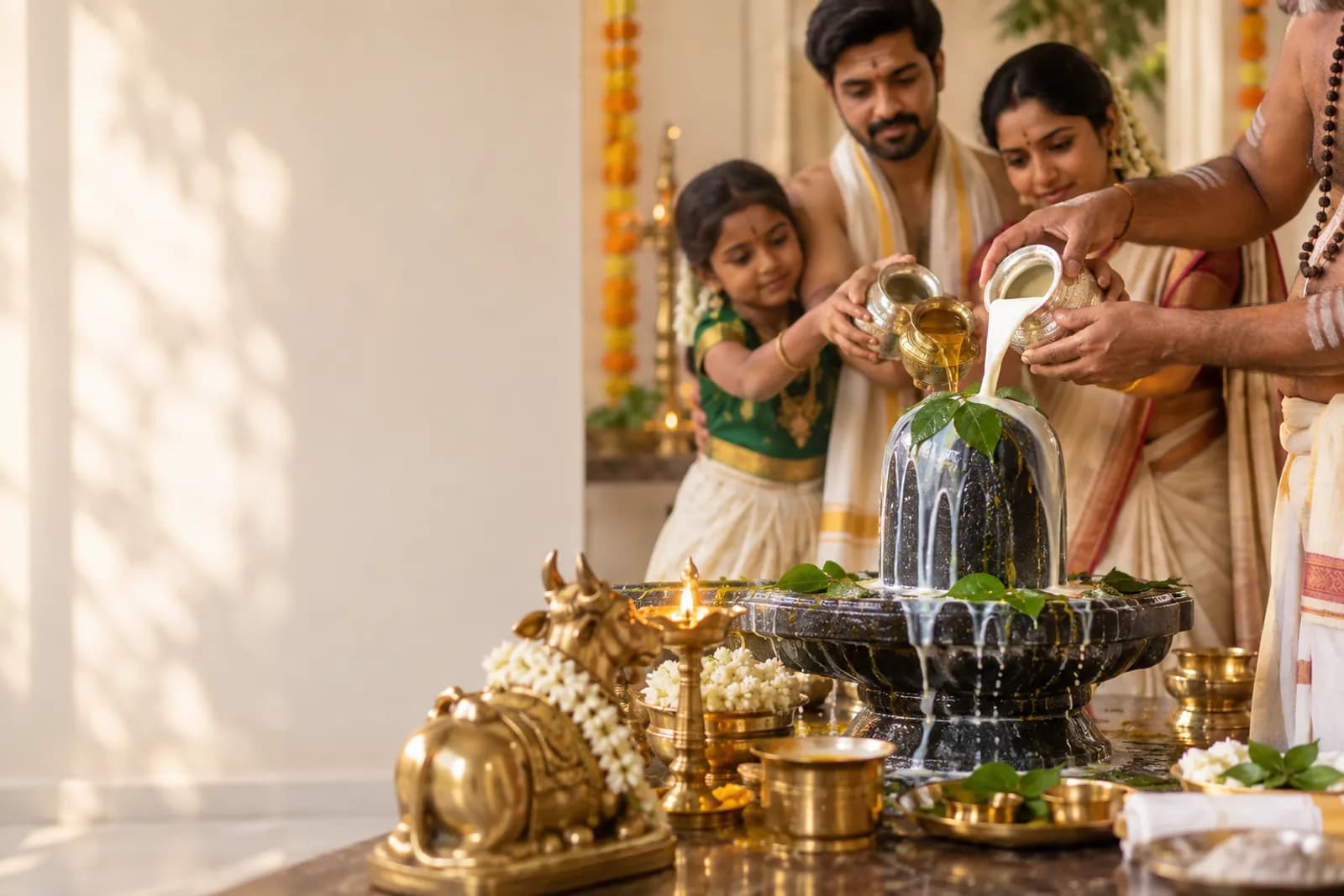
Maha Rudrabhishekam is an elaborate form of worship dedicated to Lord Shiva in His Rudra aspect. The ceremony centres around Abhishekam of the Shiva Lingam along with the recitation of sacred Shiva mantras, especially Sri Rudram, and offerings performed according to the relevant Vedic or family tradition.
On this page
- Quick Overview
- What Is Maha Rudrabhishekam?
- Significance
- When It Is Performed
- Maha Rudrabhishekam vs Rudrabhishekam
- What Is Performed
- Sri Rudram
- Samagri
- Traditional Benefits
- At Home
- In a Temple
- Who Performs It
- How Long It Takes
- Who It May Suit
- How to Prepare
- Maha Rudrabhishekam in Hyderabad
- Why Choose Anugraha Siddhi
- How to Book
- Service Details
- Frequently Asked Questions
Compared with a regular Rudrabhishekam, a Maha Rudrabhishekam may involve a larger scale of chanting, offerings, Kalasha arrangements or collective participation. The exact procedure, number of recitations, materials and duration can vary according to the sampradaya, family tradition, temple practice and sankalpam.
At Anugraha Siddhi, families and individuals can enquire about Maha Rudrabhishekam Purohit services in Hyderabad and suitable arrangements for their ceremony.
Quick Overview
| Aspect | Details |
|---|---|
| Service | Maha Rudrabhishekam |
| Deity | Lord Shiva |
| Primary purpose | Devotional worship, prayer and traditional spiritual observance |
| Main ritual | Abhishekam of Shiva Lingam with sacred offerings |
| Important recitation | Sri Rudram and other Shiva-related mantras, according to tradition |
| Common occasions | Maha Shivaratri, important personal or family occasions, collective worship and specific sankalpams |
| Performed by | Purohit or Vedic priest according to the applicable tradition |
| Location | Hyderabad and suitable locations based on arrangement |
| Samagri | Depends on the selected vidhanam and family tradition |
| Booking | Call or WhatsApp +91 90320 22323 |
What Is Maha Rudrabhishekam?
Maha Rudrabhishekam is a traditional Shiva worship ceremony centred on the Abhishekam of Lord Shiva, usually represented by a Shiva Lingam.
The word Abhishekam refers to the ritual bathing or anointing of the deity with sacred substances. In Rudra worship, the Abhishekam is accompanied by the recitation of Vedic hymns and Shiva mantras according to the tradition being followed.
The term “Maha” indicates an elaborate or expanded form of the worship. However, there is no single universally identical format for every Maha Rudrabhishekam. The scale and procedure can differ depending on the sampradaya, temple or family tradition, number of priests, chanting requirements and the sankalpam.
The exact vidhanam should be confirmed with the Purohit before the ceremony.
What Is the Significance of Maha Rudrabhishekam?
Rudrabhishekam is traditionally associated with devotional worship of Lord Shiva and the chanting of Sri Rudram. The Abhishekam represents an offering of devotion and reverence to Shiva.
Many devotees perform Shiva Abhishekam as part of their spiritual practice with prayers for:
- Peace and spiritual well-being
- Family harmony
- General well-being
- Strength during challenging periods
- Devotional connection with Lord Shiva
- Fulfilment of a personal sankalpam
- Gratitude and prayer
These are traditional devotional beliefs, not guaranteed outcomes. Maha Rudrabhishekam should therefore be understood primarily as a sacred form of Shiva worship rather than as a guaranteed remedy for a particular problem.
When Is Maha Rudrabhishekam Performed?
Maha Rudrabhishekam may be performed on occasions considered significant for Shiva worship. Commonly associated occasions include:
Maha Shivaratri
One of the most prominent occasions for Shiva worship. Rudrabhishekam is performed in many traditions during this festival, with the timing and ritual format varying by temple and sampradaya.
Mondays
Monday is traditionally associated with Lord Shiva, and devotees may choose to perform Shiva worship and Abhishekam on this day.
Pradosham
Pradosha observances are traditionally associated with Shiva worship. Families may choose an appropriate Abhishekam according to their tradition.
Personal Sankalpam
A family or individual may also arrange Maha Rudrabhishekam for a particular devotional purpose, family occasion or spiritual observance.
Temple or Community Events
Because Maha Rudrabhishekam can be performed on a larger scale, it may also be arranged as a collective or temple-based worship ceremony.
The appropriate date and time should be confirmed with the Purohit according to the relevant Panchangam, family tradition and ritual requirements.
Maha Rudrabhishekam vs Rudrabhishekam
Although both ceremonies involve Shiva Abhishekam, they should not automatically be treated as identical.
| Rudrabhishekam | Maha Rudrabhishekam |
|---|---|
| Shiva Abhishekam with Rudra-related chanting | More elaborate form of Rudra worship |
| May be performed by an individual or family | May involve a larger-scale or collective arrangement |
| Usually simpler in scale | May involve additional chanting, Kalashas, offerings or priests |
| Duration depends on the chosen vidhanam | May require more time depending on scale |
| Suitable for regular devotional worship | Often selected for larger sankalpams or special observances |
| Procedure varies by tradition | Procedure and scale vary by sampradaya and arrangement |
There is no universal rule that every Maha Rudrabhishekam must follow exactly the same number of recitations or use an identical list of materials. The ceremony should be planned according to the applicable tradition.
What Is Performed During Maha Rudrabhishekam?
A Maha Rudrabhishekam may include several stages depending on the selected vidhanam. A general structure may include:
- Preparation of the worship space
- Sankalpam
- Preliminary Ganapathi worship
- Kalasha preparation or invocation where applicable
- Sri Rudram recitation
- Shiva Lingam Abhishekam
- Offering of prescribed Abhisheka dravyas
- Shiva archana
- Bilva leaves and flowers
- Alankaram
- Aarti
- Prasadam distribution
The exact order and inclusion of individual rituals may differ according to family custom, Vedic tradition and the Purohit's prescribed procedure. For the confirmed stage-by-stage structure offered for a booking, see the Maha Rudrabhishekam service page.
Sri Rudram in Maha Rudrabhishekam
Sri Rudram is an important component of many Rudra worship traditions.
The chanting of Sri Rudram accompanies or forms an important part of the ritual depending on the selected procedure. The number of recitations and the specific chanting format can vary.
Ask for the agreed chanting requirement to be specified before booking; no single recitation count applies to every Maha Rudrabhishekam.
If your family follows a particular Vedic or regional tradition, inform the Purohit before the ceremony so the arrangements can be discussed accordingly.
Maha Rudrabhishekam Samagri
The required samagri can vary depending on the chosen procedure and the number of offerings. Common materials may include:
- Pure water
- Milk
- Curd
- Ghee
- Honey
- Panchamrit
- Bilva leaves
- Flowers
- Sandalwood or Gandham
- Akshata
- Vibhuti
- Fruits
- Coconut
- Betel leaves
- Betel nuts
- Incense
- Camphor
- Lamps and wicks
- Kalashas
- Naivedyam
- Clean cloth
- Other items prescribed by the Purohit
Not every ceremony requires every item listed above. Ready-assembled materials can also be checked through the Anugraha Siddhi pooja kits.
The final samagri list should be confirmed before booking because requirements can differ according to the selected Maha Rudrabhishekam vidhanam and family tradition.
What Are the Traditional Benefits of Maha Rudrabhishekam?
Devotees traditionally perform Maha Rudrabhishekam with prayers for spiritual and personal well-being. Commonly expressed devotional intentions include:
Peace of mind
The chanting and worship may form part of a person's regular spiritual practice and prayer for inner peace.
Family harmony
Families may perform Shiva worship together as a devotional practice and collective prayer.
Spiritual purification
Abhishekam and mantra recitation are traditionally regarded as forms of devotional purification and surrender.
Strength during difficult periods
Some devotees choose Rudra worship when going through personally challenging circumstances.
General well-being
Families may perform the ceremony with prayers for health, happiness and overall well-being.
Devotional fulfilment
A Maha Rudrabhishekam may be undertaken as part of a personal sankalpam or spiritual observance.
These are traditional religious beliefs, not scientifically proven or guaranteed results.
Can Maha Rudrabhishekam Be Performed at Home?
Yes, a Maha Rudrabhishekam can be arranged in a suitable home setting when the required space, materials and ritual arrangements are available.
Before planning a home ceremony, consider:
- Available space
- Shiva Lingam or appropriate worship arrangement
- Water and Abhishekam drainage
- Required samagri
- Seating arrangements for priests and participants
- Number of priests required
- Chanting arrangements
- Cleanliness of the worship area
- Prasadam arrangements
For larger-scale ceremonies, the space and logistical requirements may be greater. Anugraha Siddhi can be contacted to discuss whether your home or selected venue is suitable for the planned ceremony.
Can Maha Rudrabhishekam Be Performed in a Temple?
Temple-based arrangements may also be possible depending on the temple's rules and availability.
If you wish to perform Maha Rudrabhishekam at a specific Shiva temple, first confirm:
- Whether Abhishekam is permitted
- Available dates
- Available timings
- Required samagri
- Priest arrangements
- Number of participants
- Temple-specific procedure
- Any booking or permission requirements
The temple's own traditions and procedures should take priority over a generic service format.
Who Can Perform Maha Rudrabhishekam?
Maha Rudrabhishekam is generally performed with the guidance of a qualified priest or Purohit familiar with the relevant ritual tradition. The appropriate priest may depend on:
- Family tradition
- Veda or Sampradaya
- Regional practice
- Type of ceremony
- Number of recitations
- Number of participants
- Venue
- Specific sankalpam
If your family follows a particular tradition, mention it while making the enquiry.
How Long Does Maha Rudrabhishekam Take?
There is no single fixed duration for every Maha Rudrabhishekam. The time can depend on:
- Number of priests
- Number of Sri Rudram recitations
- Number of Kalashas
- Abhishekam materials
- Additional rituals
- Number of participants
- Chosen sampradaya
- Venue arrangements
A basic Rudrabhishekam may take around one to two hours in some formats, while an elaborate Maha Rudrabhishekam can take longer depending on its scale. The final expected duration should be confirmed with the Purohit when the ceremony is planned.
Who Can Benefit from Arranging Maha Rudrabhishekam?
Maha Rudrabhishekam may be suitable for:
- Individuals seeking Shiva worship
- Families wishing to perform a larger Shiva ceremony
- Devotees observing Maha Shivaratri
- Families undertaking a personal sankalpam
- Groups planning collective Shiva worship
- Devotees wishing to perform an elaborate Abhishekam
- Families looking for Purohit assistance in Hyderabad
The ceremony can be planned according to the family's devotional requirements and applicable tradition.
How to Prepare for Maha Rudrabhishekam
Decide the preferred date
If you already have a preferred date, share it with the Purohit. If you need guidance regarding an appropriate date, ask about Panchangam-based Muhurtham guidance.
Confirm the venue
Decide whether the ceremony will be conducted at home, at a temple or at another suitable venue.
Keep family details ready
Where applicable, keep the names of participants, Gotra, Nakshatra, Rashi and sankalpam details available. Not every detail is required for every ritual, so confirm the exact requirements with the Purohit.
Confirm the samagri
Ask whether the Purohit will provide the samagri or whether the family should arrange it.
Confirm the ritual format
Before booking, clarify the number of Purohits, Sri Rudram recitation requirements, Abhishekam materials, expected duration, samagri responsibility, prasadam arrangements and venue requirements. This avoids confusion on the day of the ceremony.
Ready to plan the ceremony? The service page covers packages, venue planning and the booking checklist.
Maha Rudrabhishekam in Hyderabad
Anugraha Siddhi provides Purohit and Vedic ritual services for families in Hyderabad.
The broader service coverage includes Poojas, Homams, Vrathams, Abhishekams and other Hindu rituals. The Abhishekam services list Maha Rudrabhishekam alongside Rudrabhishekam and Ekadasha Rudrabhishekam.
The service can be discussed for locations across Hyderabad, including areas such as:
- Kukatpally
- KPHB
- Nizampet
- Miyapur
- Bachupally
- Pragathi Nagar
- Hyder Nagar
- Madhapur
- Hitech City
- Kondapur
- Gachibowli
- Manikonda
- Secunderabad
Availability should be confirmed for your preferred date and location before booking.
Why Choose Anugraha Siddhi for Maha Rudrabhishekam?
Anugraha Siddhi is a Hyderabad-based provider of Purohit, Hindu Pooja, Vedic ritual and spiritual services. Its services include:
- Experienced Vedic Purohits
- Traditional Hindu rituals
- Pooja and Abhishekam services
- Muhurtham and Panchangam guidance
- Hyderabad service support
- Pooja Samagri and ready-to-use kits
Services can be arranged beyond Hyderabad based on requirements. For Maha Rudrabhishekam, the most important step is to discuss the required vidhanam, chanting, samagri and scale before confirming the booking.
How to Book Maha Rudrabhishekam
Booking can be kept simple.
Contact Anugraha Siddhi
Call or WhatsApp +91 90320 22323.
Share your requirements
Provide the preferred date and time, location, number of participants, whether it is a home or temple ceremony, any specific family tradition and available Gotra or Nakshatra details, if applicable.
Confirm the ceremony format
Discuss the Purohit requirement, Sri Rudram recitation, samagri, duration, sankalpam, prasadam and any additional arrangements.
Confirm the booking
Once the ceremony details are agreed upon, confirm the booking and preparation requirements with the Anugraha Siddhi team.
Maha Rudrabhishekam Service Details
| Service feature | Details |
|---|---|
| Service | Maha Rudrabhishekam |
| Deity | Lord Shiva |
| Ceremony type | Shiva Abhishekam / Rudra worship |
| Suitable venue | Home, temple or agreed venue |
| Purohit | Available through Anugraha Siddhi enquiry |
| Sri Rudram | According to the agreed ritual format |
| Samagri | To be confirmed based on the selected vidhanam |
| Muhurtham guidance | Can be discussed where required |
| Hyderabad service | Available based on location and date |
| Online enquiry | Call or WhatsApp |
| Contact | +91 90320 22323 |
Frequently Asked Questions
1. What is Maha Rudrabhishekam?
Maha Rudrabhishekam is an elaborate form of Shiva worship centred on Abhishekam of the Shiva Lingam along with Rudra-related mantra recitation and traditional offerings. The exact procedure and scale vary according to sampradaya, family tradition and the sankalpam.
2. What is the difference between Rudrabhishekam and Maha Rudrabhishekam?
Both involve worship of Lord Shiva through Abhishekam and mantra recitation. Maha Rudrabhishekam generally refers to a more elaborate or larger-scale form of Rudra worship, potentially involving additional chanting, offerings, Kalashas or priests. The exact distinction can vary by tradition.
3. What is the significance of Maha Rudrabhishekam?
Devotees traditionally perform Maha Rudrabhishekam as an expression of devotion to Lord Shiva and with prayers for peace, well-being, spiritual purification and family harmony. These are traditional religious beliefs and should not be treated as guaranteed outcomes.
4. When is Maha Rudrabhishekam performed?
It may be performed on Maha Shivaratri, Mondays, Pradosham or other personally significant dates. Families may also arrange it for a specific sankalpam or collective worship. The appropriate date and procedure should be confirmed according to the relevant tradition.
5. Can Maha Rudrabhishekam be performed at home?
Yes. It can be arranged at home if there is adequate space and the required ritual arrangements can be made. For larger ceremonies, additional space and logistical arrangements may be necessary.
6. What samagri is required for Maha Rudrabhishekam?
Common materials can include water, milk, curd, ghee, honey, Panchamrit, Bilva leaves, flowers, sandalwood, Akshata, Vibhuti, fruits, coconut, incense, camphor and other prescribed offerings. The exact list varies by the chosen vidhanam and should be confirmed before the ceremony.
7. How long does Maha Rudrabhishekam take?
There is no fixed duration for every ceremony. The time depends on the ritual format, number of priests, Sri Rudram recitations, offerings and scale of the ceremony. The expected duration should be confirmed when booking.
8. Is Sri Rudram recited during Maha Rudrabhishekam?
Sri Rudram is an important component of many Rudra worship traditions. The exact recitation format and number of recitations can vary, so the chanting requirements should be confirmed with the Purohit before booking.
9. Can I arrange Maha Rudrabhishekam in Hyderabad?
Yes. Anugraha Siddhi provides Purohit and Vedic ritual services in Hyderabad. Contact +91 90320 22323 with your preferred date, location and ceremony requirements to confirm availability.
10. How can I book Maha Rudrabhishekam with Anugraha Siddhi?
Call or WhatsApp +91 90320 22323 and mention that you want to enquire about Maha Rudrabhishekam. Share your preferred date, location and any specific ritual requirements. The team can then discuss the ceremony format, Purohit arrangements, samagri and booking process.
Book Maha Rudrabhishekam in Hyderabad
Planning a Maha Rudrabhishekam for your family or a special devotional occasion? Anugraha Siddhi can help you discuss the appropriate Purohit arrangement, ceremony requirements, samagri and preparation based on your chosen tradition.
Book Maha Rudrabhishekam WhatsApp +91 90320 22323
About Anugraha Siddhi
Anugraha Siddhi provides Purohit services, Hindu Poojas, Homams, Abhishekams, Vedic rituals and spiritual services in Hyderabad. The service range includes traditional ceremonies performed according to the applicable family, regional and Vedic traditions.
Address
Metro Pillar No: A689, Dr Atmaram Estates, 3rd Floor, Nizampet X Roads, beside Sri Bhramaramba Theatre, near Jntu Metro Station, Hyderabad, Telangana 500072
Contact
Call or WhatsApp: +91 90320 22323
Website: anugrahasiddhi.com
Related Services
- Maha Rudrabhishekam — Book the ceremony
- Rudrabhishekam — Standard Shiva Abhishekam
- Ekadasha Rudrabhishekam — Extended Rudra worship
- Shiva Pooja — Lord Shiva worship
- What is Rudrabhishekam? — The Sri Rudram explained
- Abhishekams — All abhishekam services
- Pooja Kits — Ready-assembled samagri
- Panchangam — Calendar reference
- Pooja Guides — More articles